
There were three people who could have seen what happened but did not. The road beneath the slope on which the bighorn sheep frolicked curved around a bend in the river, and at that bend there was an eddy that held trout in the shadows, which attracted a fisherman who stood in the early season water in his waders. The embankment above and the sound of the river below drowned out most of the road noise. He could feel the clamp of the cold on his legs as the waders sucked tight against his calves. His eyes were down, pointed toward the shaded hollow where he hoped a big trout lurked. So, while he heard the crash and saw the aftermath, he didn’t see the cause.
The two others who could’ve borne witness were similarly distracted. A rockface, sheer and clean, loomed above the head of the fisherman on the south side of the river. A small trail led to its base from the bend. On the cliff that day were two climbers. They, too, only saw the aftermath, not the cause. One of them was in the act of climbing, eyes focused on stone, searching for handholds and footholds with which to progress upward. The other held the rope and was attentively belaying, watching his partner ascend, ready to catch a fall if one should take place.
Thus, when the crash occurred, the only mammal who watched it happen was the bighorn sheep. The same one whose small leap from ledge to slope had dislodged the first stone, a smallish one, about the size of a bowling ball, which began to tumble downhill. The sheep, unfazed, stopped and turned its head, watching. First to ensure that no other members of its herd were below and imperiled. Then out of curiosity or boredom or some other unknown motivation. And the bowling ball then struck another rock that had been perched on another ledge for some amount of time – not of geological significance but certainly of human significance. It had been perched there as the result of a storm or erosion or some prior interaction with gravity. And this perched rock was larger, not refrigerator sized but bigger than a microwave oven, and after being struck by the bowling ball it fell off the ledge, bounced once, twice, then cartwheeled over the roadcut as if traveling half an elliptical orbit.
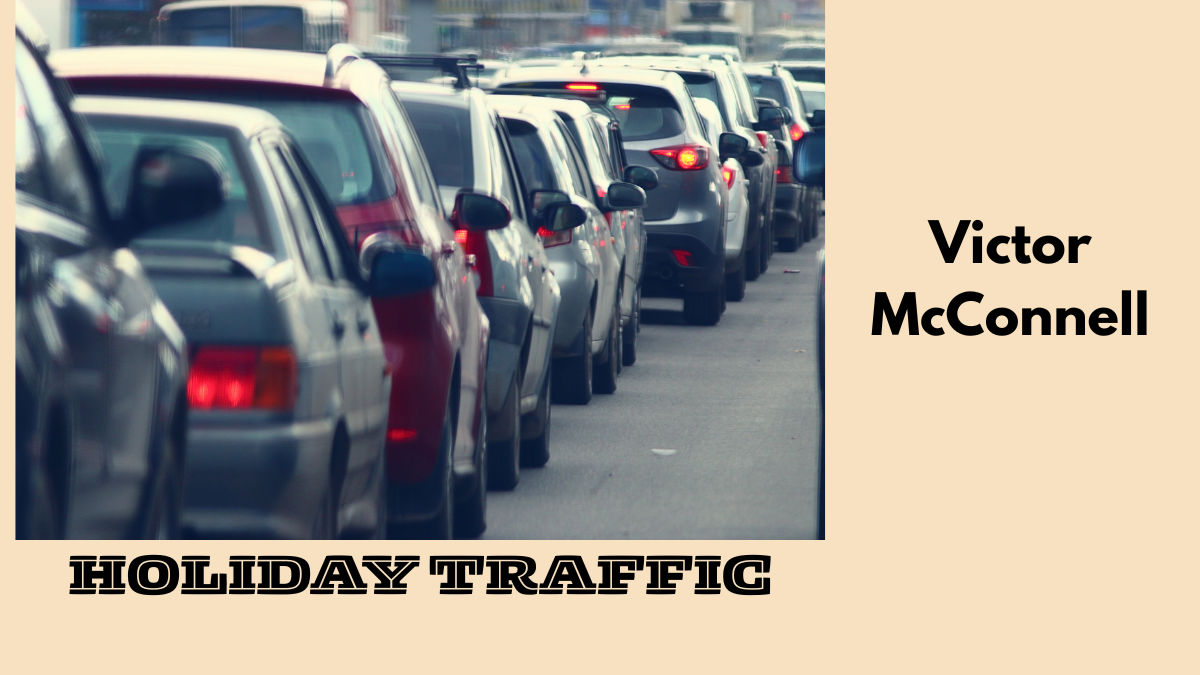
Even though it was Memorial Day weekend, Michael thought they’d left early enough to avoid the heavy traffic heading west into the mountains. And so he was surprised when, less than half an hour after leaving Denver, they were stopped in a line of cars on Highway 6, the road that parallels Clear Creek and intersects with Interstate 70 about thirty miles west of the city. They were far enough back in the line of cars that they couldn’t tell the reason for the stoppage.
“Do you think we should turn around, Michael? You know, go back toward Denver and take 70 instead?” Susan’s tone suggested that was exactly what she thought they should do.
“No. We’re more than halfway there. Surely if it were something bad they would be turning us around already. And if we go back we’ll just wind up stuck in 70 traffic the whole way. We may not get the best parking spot but it’s early enough that we’ll still have most of the ski day.” Arapahoe Basin was set to close the next week, and Michael always insisted that they come out for one last day near the end of the season. “Jennifer, you and your brother should be thankful that we can even go skiing in May. It’s pretty cool, isn’t it?”
“Whatever, Dad,” said Jennifer from the backseat, “I think Mom is right. Remember last year when we sat in traffic here for like an hour?”
“I do, Jennifer. Thank you for the reminder. However, just because we were stuck for an hour a year ago doesn’t mean that is what will happen this time.”
Anthony kept staring at his iPad and didn’t take his headphones off. Anthony would’ve been happy if the drive took four hours instead of one, as long as his device was fully charged.
Half an hour passed. Michael pretended not to notice, idly thumping the steering wheel to the music. Susan followed her children’s lead and turned to her own phone. No one spoke. When they hit the one-hour mark, Michael just shook his head and said, “Goddammit.”
Susan turned her phone face down on her lap and gave him a long look. Jennifer did the same thing.
Michael tried to hold his irritation in. “I could do without you two second guessing everything. I made what I thought was a good decision.”
“Dad, I wish you would just let me ride out here with Ben’s family and stay with them in Vail. I could’ve come out last night. God, I can’t wait ‘til next year when I can drive myself.”
“I told you no for a reason, Jennifer. You’re fifteen. It’s not appropriate for you to stay at your boyfriend’s house for a weekend.”
“Why can’t we get a place in the mountains, anyway? If you’re going to make us come out here so much and everything. Also, it’d be better for the environment—less driving, you know. Don’t you care about the environment, Dad?”
Michael was ignoring her but then Susan chimed in. “Yes, Michael. Why can’t we get a place in the mountains?”
Michael had thought he would make partner that year, had told Susan that he would and that would mean he would have more time and they would have more money. But the firm had grown less than expected, or so he’d been told. Your book of business isn’t quite big enough, they said, but you’re on track. Keep it up another year.
“I’m sorry, Susan. You think I’m any less frustrated than you?” The car in front of them moved forward a few feet and then stopped.
“Ugh,” Jennifer said. “I thought we were moving. Can’t we turn around? I didn’t even really want to come.”
Michael turned toward her in the back seat. “For God’s sake, Jennifer. I thought I would take this route because it would be a nice drive. The canyon is lovely in the spring—maybe if you’d stop complaining or staring at your phone you could look out your window and enjoy the scenery. You might even see a bighorn sheep or something. I’m sorry as hell for trying to give this family a nice, shared experience. I won’t do it again.”
Susan muttered something about the joy of shared experiences.
“What?” Michael asked.
She shook her head. “Nothing.”
Just then, two police cars and a fire truck passed them on the left with sirens on. A third police car then came up more slowly with the cop holding a hand out the window, twirling his finger and pointing back toward the east, signaling that they were closing the road and everyone needed to turn around.
“I don’t want to hear a word,” Michael said, as started to make the three-point turn.
Darryl’s truck was getting filled with its second load of the day from the quarry near the intersection of Highway 6 and Interstate 70. He would transport the gravel to a construction site on the east side of Denver, dump it, then come back. It was the Friday before Memorial Day weekend and the road heading westbound was already full of mountain bikers and hikers and even skiers trying to get their last weekend in at Arapahoe Basin. The sun was shining, which meant more traffic. Just a little rain would keep half these people at home. Eastbound was still moving, but he knew when he returned for his third load he’d be sitting in that centipede of cars and it would take twice as long as normal. He was already bitter just thinking about it. Pulling out of the quarry, he was tempted to turn right and have a drink at Two Bears Tavern, but the goddamn trucking company could track him on GPS and might notice. When he was at Two Bears last week, a guy at the bar whose grandfather had been a miner told him that they turned an old ghost town up toward Central City into a disc golf course. He hadn’t believed it until he drove up there one day after a shift and saw it himself. He sat in the ruins of one of the buildings where the disc golfers couldn’t see him and drank a six pack. It was ridiculous.
He had plans to go to Central City after work that evening to meet up with his brother, Caleb. He preferred Central City with its dated, low-slung casinos as opposed to Black Hawk, where those high-rise resorts that make no sense just pop right up out of the mountains. He wished he could’ve been out there a hundred years before, chasing real gold instead of casino chips. Still, the casinos were better than the resort towns. If he did well at the slots, maybe he’d even get a room and he and his brother could stay the night, avoid the late-night drive down from the mountains. Neither of them had to work that weekend, and God knew he wasn’t going to drive west on 70 and fight with every other jackass on the road.
His brother had switched from driving gravel trucks to working construction along Highway 6. There was money and public support for the hike and bike trail that they were forever building along the river. Darryl couldn’t stomach it, even though Caleb said he could make twice as much doing that. But the idea of working on that project, watching every tourist drive by—or even worse, standing holding a stop sign when the road was shut down to one lane—well, it was too much. Driving the gravel truck for half the pay was better than that.
He gave his brother a hard time about it. About the new job and the new girlfriend. Caleb had even started skiing some that winter, as the new girlfriend lived in Georgetown and got free lift tickets through her job for Winter Park. Plus she was a mountain biker. He told her and his brother that there was nothing worse than being out for a quiet walk in the woods and having bicycles come rattling by you. He was only half serious but she didn’t laugh, and he told Caleb later that she didn’t have much of a sense of humor.
Darryl had one kid when he was nineteen and another at twenty-one and now both were grown and gone, moved out of state. His brother was a decade younger, not yet forty, and Darryl wasn’t sure if he would marry this mountain biker chick or not. He didn’t really care, to tell the truth. She was gone that weekend, which was why Caleb had agreed to go to the casino with him.
Darryl could feel his blood pressure drop as he downshifted, navigating the curves. It had probably been a year since Caleb joined him for a night of gambling, and he was looking forward to it. Maybe on Saturday they’d do something else, catch a sci-fi flick or something. It had been a while since he’d looked forward to something that much, really, and despite the cars full of tourists heading in the other direction with their roof racks and skis and mountain bikes, Darryl was smiling.
The bighorn stood still as a statue, watching the last domino tumble through space. The sheep didn’t know what the gravel truck was, exactly, but it could tell in advance where the large rock was going to land.
Darryl liked science fiction films, and he might’ve thought of asteroids or meteors—he could never remember the difference—if he had seen the stone hurtling through the air in the final second before his truck on its own orbital path collided with the oversized microwave rock, which collapsed the roof of his cab onto his head, thereby collapsing his head into his neck and causing him to jerk the steering wheel, which caused the truck’s front wheels to turn at too high of a velocity, resulting in the truck skidding then flipping, the trailer turning over and dumping its payload across the road as the truck itself became unhitched and completed its roll, further crushing the cab and rolling again, off the road and into the river. Not into the bend where the fly fisherman fished but into an unpopulated spot a hundred feet away. Unpopulated, that is, by humans, though presumably when the truck crashed into the water the fish, alert and skittish from years of fishing pressure, would’ve scattered upstream or down, quick enough to survive their own meteor.
Meanwhile, traffic would be stopped along Highway 6 for several hours until the road could be cleared, and Darryl’s death would be recorded as an accident by the gravel company. User error, a driver driving too fast, losing control, flipping over into the river.
Caleb would get a call and would spend the night on the phone with his girlfriend, crying, talking about how he and Darryl were supposed to meet up that night. Michael and his family would return home, where each member would retire to separate rooms; Michael to the living room to watch TV, Susan to the bedroom to read, and each kid to their own room to keep doing whatever they were already doing on their phone or iPad. None of them would ever know the cause of the road closure that day.
The two climbers and the fisherman would be the first to arrive on the scene of the accident. The fisherman mere minutes after the crash, and the climbers about a half hour later, after they were able to rappel to the base of the cliff. By then, the fisherman had already pulled Darryl’s body out of the water and called 911, though it was clear Darryl was dead.
The climbers asked what they could do and the fisherman said, “Nothing, I don’t think.”
They all waited together until the police cars and firetruck arrived. Then, with the canyon sure to remain closed for a couple of hours until someone could haul Darryl’s gravel truck up out of the river, the climbers returned to their cliff, not knowing what else to do. The fisherman made a similar decision and returned to the nearest fishing hole. He began casting, not noticing the new, oversized microwave block that was now a fixture on the riverbank, intermingled with other stones. It was positioned right at the water’s edge. Once the spring snow fully melted, the water level would rise, and, when the current grew strong enough, it would tumble the stone off its new perch and wash it downstream until it lodged into a more permanent position along the bottom of the riverbed, where it would sit indefinitely, out of sight, growing smoother and more polished, all rough surfaces—and flecks of paint or glass or blood—washed away.
Victor McConnell has a 14-yr-old son and lives in Colorado. His first book, a collection of short stories titled “Even When the Bones Have Thinned” is scheduled for publication in 2026. A chapbook of his poetry is currently available from Bottlecap Press. More of his work can be found at www.victormcconnellauthor.com.
Comment