
Explore the latest art by writers, photographers, illustrators, artists, and more. See what’s happening today in the creative backyard we know as the internet.

Parched by Tushar Sen
A bomb fell—
like a rogue kite,
stringless, nameless,
aiming nothing, claiming everything.
Blisters on that body—
like boils on bubble wrap,
waiting, bursting, multiplying.
The place hissed,
like a silenced furnace
breathing through broken walls.
In the market square,
a skull lay atop a fountain,
choked with blood—
to ward off the spirits
of those who died a “natural death.”
Fresh rubble,
still warm,
drew hands the way gold does.
Not mourners, collectors.
They came softly,
like it was a harvest.
Shoes were eased
from the feet of the buried
without asking for permission.
Gemstones pinched
from fingers gone cold.
Piggy banks split open—
their small treasures
up for grabs.
Business as usual—
no one took notice,
no one complained.
Barrows carried bodies—
unclaimed,
hurried to a deep patch of earth
dug out to accommodate them all.
Ambulances stood in the heat,
with hospitals gone,
medical aid
traded by the roadside.
The city now heard
only sirens,
craving baby cries.
A stray rocket stuck on a rooftop—
ashamed of its own sterility,
hiding its nose from passersby
who pelted rage-filled stones.
Outside shelter homes,
the queues never thinned.
Somebodies and nobodies
waited their turn,
hoping for a roof tonight,
some hot stew maybe—
or perhaps not.
Tushar Sen is a finance professional who also engages in sustained creative and scholarly writing. He is the author of Pandora’s Box, a collection of short stories available on Amazon, Barnes & Noble, and Audible. In 2020, he wrote and produced the short film Zulfi, which screened internationally and received 22 laurels across film festivals. His essay, “Vishnu’s Umbilical Cord,” was published by LongformReads (https://longformreads.com/2026/03/28/vishnus-umbilical-cord-how-a-quantum-entangled-type-iii-civilization-answers-a-5000-year-old-question/). His poetry has appeared in Lekh (https://lekh.co/the-poems-winning-aint-the-road-less-travelled-and-the-quill/) , Indian Review (https://indianreview.in/poetry/the-waiting-room-tushar-sen/) and SpecPo Verse (https://specpoverse.org/vol-2%2C-issue-1-2026)
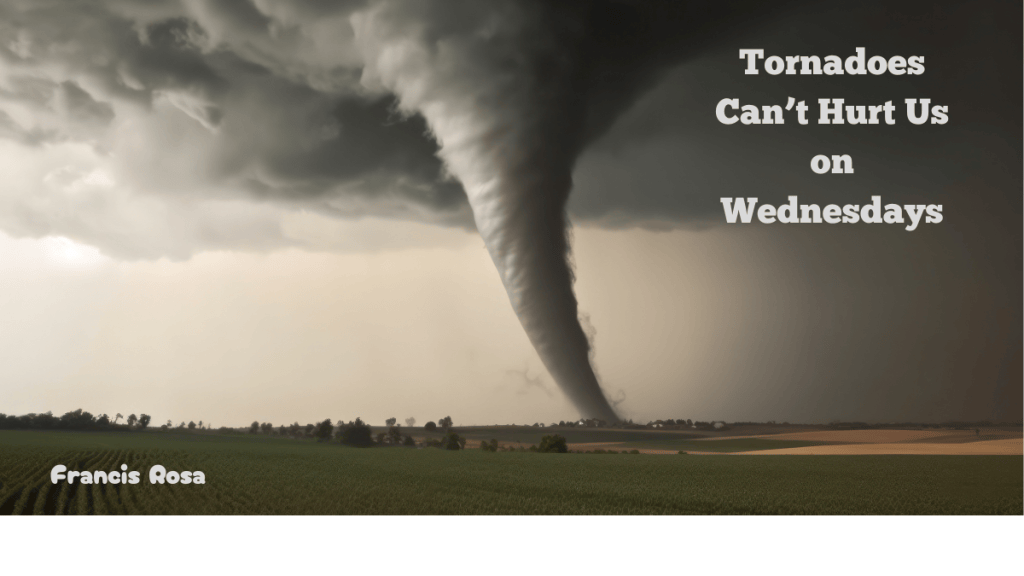
Tornadoes Can’t Hurt Us on Wednesdays by Francis Felix Rosa
Twigs snapped underfoot as he trudged towards a patch of thistles and milkweed huddled down the slope. Stalks reached up, cracking open the robin’s-egg blue sky, and fronds loomed, forging a place of dark shade and silence. It made Tanner jumpy, but that was nothing new. The jumpiness was a thing in his bones now that he couldn’t pry out if he tried.
Twisting into woodland, everything was full of mingling scents: leaf mold, fresh morning dew, decaying birch and crushed coneflower seedheads, sickly sweet in the wind. In the old days, he’d never guessed forests held so many smells, that a slight gust could make or break his day, that a dampness touching the breeze would be so clear, like being pelted with water balloons as a child. But that was a different time, he’d been a different size then.
Russo coughed beside him, as if to bring Tanner hurtling back to the moment. Russo kept hacking, then wiped his mouth. He hadn’t sounded well lately. It was the springtime air. Pollen like pellets in the lungs. “We better get a move on.”
Tanner carefully stepped into the high grove of milkweed. Something yellow with zebra stripes skulked in the distance, but settled back on its perch. He clambered up, unsheathed a knife. It was a good clean cut into the milkweed pod, withering on bare ground. White silky cords tumbled out, soft as kitten’s fur.
Russo brought the sackcloth close. They grabbed as many white strands as possible, sweeping floss into the bag. Their movements were precise and fast. Still, Tanner’s forearms burned wildly from the sap. He wanted to curse, but Russo was once a religious man and Tanner never could glean Russo’s stance on blasphemy these days. These weren’t things people talked about much now. He grimaced, plunging his arms into a long bulb of dew overhanging them both.
A great swooping occurred. A terrifying routine moment in which Tanner thought, “This is the end.” Rather than thinking of Christopher or Ainsley, rest her soul, the only deranged thought he mustered was that it was a beautiful day to die, and he’d never pictured dying on a beautiful blue-sky kind of day.
It was only a Monarch; its snout forming a spiral black curl. It flapped silently, once, twice, then gone.
“Scared the bejesus out of me.”
Tanner’s heart pounded. The quiet morning loveliness vanished.
They returned to base camp, a sparse collection of aluminum and tin barracks, most already corroding.
Argyle hobbled toward them, face red.
“What is it?” Tanner dropped the sackcloth and fine threads spilled out. “Chris?”
“No, nothing like that.” Argyle’s hands fiddled with his own staff as he searched for words.
“Spit it out.”
“We need to move on.”
“Move on?” He looked at Russo.
Russo shrugged apologetically. “It’s like I’ve been trying to tell you. Been getting a sense. The Lord directing me maybe.”
So, he still believed in God. Tanner noted this for later. It was good to keep a mental file of those in the barracks.
They walked past pebbled walls and trenches as Argyle and Russo babbled about atmospheric pressures, and dew on leaves, and the damp woody musk polluting the air.
“What on God’s gigantic earth are you two on about?”
Argyle gulped, swallowing harsh words, “I can feel it, in my bones. A rain coming. A big one. Ever since, well… you know. It’s more like a crushing python squeezing at my joints. We’re not on high enough ground.”
Argyle couldn’t even say the words. Tanner scoffed and goaded, “Ever since what?”
They both looked down. Argyle still wouldn’t say.
Tanner glanced at the calm azure of sky doubtfully. “So, the boogeyman entered your bones and now we abandon camp?”
Argyle found his tongue, “It’s finally gonna wash away the region. The last of the sewers are long clogged up. No one to manage the old rain gardens. Not enough permeable surfaces in the street-lands. We had it good these few seasons, but it’s gonna spill down here like Noah’s flood.”
It was easy to forget that in another life, before The Reduction which Argyle couldn’t even bring himself to acknowledge now, he’d been a respectable meteorologist. In the days of television evening news, warm comfortable sofas, and pizza delivered to your door. Tanner tried not to think about old days. No use working himself up into a miserable stew of pity and loss.
“There’s no such thing as a second flood, fool!” He spat the words at Argyle, looking to Russo for help. Russo’s eyes remained downcast, perhaps reliving horrible memories. Argyle stood confused.
“Genesis,” Tanner clarified. “Noah is promised by God that the next time he ends things there won’t be a flood.”
Russo’s head darted up. He pointed at Tanner, as if delivering a homily, and snarled, “And you don’t believe God lived up to His promise? That His solution wasn’t a bit more creative this time around?”
Tanner was taken aback. He’d never seen Russo so upset.
Russo spread wrinkled hands out to the world before them, “Who’s speaking foolish now?”
Tanner grabbed the sackcloth, climbing the rails to aluminum shelter…home. The rest always insisted it couldn’t be true, but Tanner swore he could still smell the Sprite, and this scent of fizzy citrus had become a thing of warmth for him.
Inside, Christopher played with the other boys and girls, chasing, giggling, and shrieking past cots. Holcomb’s boy nearly bowled Tanner over as they fled outdoors. Chris went to slide past, but Tanner held him by the nape of his shirt.
Careful out there, no running off today.”
Chris blinked at him, with those clover-green eyes, still so young. “Dad,” he said as if Tanner were being impossibly thick, “running off is the whole point of tag.”
“No jokes Christopher,” he shook his head and let dead seriousness leak into his voice, “not today, of all days.”
Chris blinked again, going silent, emotionless, like when he was younger and a ball of sleet pinged off aluminum in the night, causing the other children to cry, terrified of the next insectoid or behemoth.
He patted Chris’s hair, sent him out, knowing perhaps he’d said too much. It was Wednesday. He still kept track.
Tornado sirens pressed into the ears at noon like a terrible omen, petrifying Chris. Even before he could talk, he’d be curled in this ball, hands clasped over his head. Tanner and Ainsley tried to make Chris understand: It was only a drill, a bright blue Midwest day, clear skies, no tornadoes. It’s just Wednesday, and that’s what they do in Green Bay on Wednesday, a mundane thing really; they practice for the swirl of destruction everyone secretly agrees will never come to pass.
He stuffed milkweed floss gently into his boy’s pillow. New cushioning would help his son sleep more soundly, end any night terrors. The room was peppered with coughing; folks bent over in cots. Pollen sent folks into a tizzy this time of year, yellow particles gripping some with fever.
Holcomb arrived frowning. Tanner didn’t like this; he’d heard mutterings all morning. Everything carries in the barracks.
“Gonna need a lot more of that milkweed fluff for any kind of flotation device.”
Okay, now he was pissed. “Who in hell says I’m making a flotation device?” he snapped.
Holcomb shrugged, “It’s your funeral. Rest of us are already packing.”
“Packing?” Jesus, just like that?
“Where are the kids?”
“Still out playing, wasn’t gonna break it to ‘em yet. Give ‘em a few good hours and I’ll gather ‘em up and explain. The trek will be hard on ‘em, I’m sure.”
“You’re not breaking shit to my son.” Holcomb had always been a scoundrel. Tanner didn’t trust him as far as he could spit. Which, come to think of it, was an awfully short distance these many years.
Holcomb just shrugged again, sauntering off to rouse others.
Tanner pictured the barracks abandoned; the corroded cylinders that had become their world, a ghost town. What a ridiculous thought. Perhaps they’d all secretly given up, decided to walk into the abyss and hope for a quick end. Known dangers were always preferable to unknown dangers. Were they too stupid, stirred up with Argyle’s prophesying, to get that?
He marched outside, determined to give Holcomb’s confederacy of dunces a piece of his mind. In the heavens, birds chittered like thunder. In the north, a strand of clouds floated in, shaped like bales of hay. Tanner was spotted before he’d covered half the distance to the men, already gathering up wagons built of duff, and thatched of twigs, and saplings, and clay to keep supplies dry and shaded.
Russo tugged him by the arm. They walked amongst old fungus and moss beds, talking as slugs raised their heads in the distance, like cattle with stalked eyes.
“This has become crazy. A sudden deadly impulse. It’s gotta end.”
Russo kicked at crumbs of soil. “How you holding up?”
“It’s a tough day. Anniversaries are tough. Never mind that, what’s our plan? Abandon all on a hunch—”
“People trust Argyle’s judgement.”
“—on a hunch! And wander through the barrens of nature in search of higher ground? Even if you’re right, a great flood comes, you’ll never get out of the marshlands and into hills fast enough. You’re talking weeks, not days, on the run from everything.”
Russo’s face turned particularly meditative before he spoke next, perhaps preparing for Tanner’s latest outburst. “We’ve been talking, and we’ve been thinking about alternative shelters we might reconsider.” He pointed to blocky highlands far on the horizon.
Tanner’s blood went cold. “You’re going back to that? Over a creak in a man’s bones?”
“Many feel the turning of seasons out here is too hard to bear.”
He sighed. A memory fragment struck him. The early days, stuck in that basement, a concrete wasteland. They’d been down there for the tornado drill, blankets and hot chocolate ready. That’d show Chris it wasn’t so bad, it could even be fun. Squeeze this bizarre fear of Wednesdays out of him. They’d been beside each other; most weren’t so lucky.
At first, he’d assumed he was falling, a fainting spell or stroke perhaps. They spent a week unsure if they’d ever make it back up the stairs, surviving on water in a pond formed from a leak too small to even notice before. They braved unspeakable cold, and cobwebs, and dust falling like soft snow.
Ainsley, his dear wife, was snatched up so very fast. The spider reached out casually and quietly, like it was just borrowing her soul for a few minutes. This crustaceous thing endowed with endless limbs, jaws, and eyes. Christopher stood there and watched, not a single tear coming to his eyes, not a flinch. Just staring, too young to understand, as if it was all a curious game of peek-a-boo.
Then sirens exploded. They were automated, sounding off even with no one large enough left to monitor them. Chris curled into a ball. Tanner carried the boy away.
Tanner returned to moss and duff. “What you said to me today, as we left the patches, you really believe that? That the end, rapture, revelations, whatever the words, has already come?”
Russo sighed, “What other explanation do you offer?”
“What does that make us? The leftovers? The sinners?”
“That would imply we’re all eternally bad people, yourself included.”
“And the children? Christopher?”
Russo raised an eyebrow, went silent. Perhaps this was why Russo never sermonized. He could have united them, like flies around honey. People love a sublime message in dark times. But maybe Russo didn’t know what to say about the darkness, didn’t accept the answers he prayed over.
“You were at Lambeau for chrissake! Homes weren’t built for us, they were built for our ancestors, for titans. Mother Nature, she provides all we need now.”
Russo motioned towards the barracks, “You live in a bottle of pop, did Mother Nature provide that?”
Tanner started to reply but he’d lost the thread of what he was arguing for. Folks had already made up their minds, scared senseless. It was a sad thought.
In the beginning, the scared rushed to connect, form shelter, tribes, some semblance of society. But houses and offices were alien kingdoms now, dens for pests, fierce, vicious, often gargantuan predators. Former riches, luxuries, and power meant nothing. A lone crumb cannot live in a god’s palace very comfortably.
This lesson took time. Locals who survived the initial shock of The Reduction headed for these palaces. They trekked up Lombardi clambering through rough pavement and halls like canyons to gather on football turf. A grand encampment in a great coliseum. Home of the Packers, now the cradle of civilization. Then pigeons arrived, along with gulls, gigantic thunderbirds descending on the unsuspecting. The rains came, drainage proved useless with no one to maintain it. Rains brought mosquitoes and flocks of gnats that transformed open flat terrain into a horror scene.
It was a tough lesson for a species used to ruling the world, desecrating it for sport, and building upon its own might, to suddenly discover they must hide in shadows, creep along, and abandon all its achievements and notions of grandeur if they were to survive.
Tanner shuddered. What were homes anyway? Caved in, towering Everests, weathered, crumbling, covered in silky arachnid threads. Lands of nests, hives, and varieties of mold and mildew, grotesque jungles of plague. Mold spores like slick festering pebbles could sicken and kill a man in one foul breath, coating frail lungs in tendrils.
The camp was named after Ainsley. Now it would be left to corrode, until the last man who ever littered, whipping a can of pop in fresh grass beside the road, was long gone.
Cloud cover darkened the mossy hollows. Tanner stormed off through duff trails, where everyone rushed about. Argyle and the older folk were insisting loudly they felt danger in their bones.
“Threatening to squeeze me dead,” Argyle claimed.
Tanner re-entered the barracks. Christopher was packing away his life, pulling milkweed floss from cushions and pillows, stuffing webs into makeshift rafts to keep them extra buoyant. Holcomb and others directed the children’s efforts. Heat rose into Tanner’s face. He clutched his son’s shoulder.
“Is it true we’re all leaving?”
Tanner shook his head. “Christopher, you’re staying right here.”
Several kids turned with confusion, searching the other parents’ faces for confirmation.
Holcomb, that weasel, tried to laugh it off. “Chris bud, we’re all going, your dad just means you have an extra special job. We need you to give a final check around the encampment so we know we didn’t forget anything.”
Tanner clutched Christopher’s shoulder tighter, so tight Christopher flinched. Shit! He relaxed his grip, “We putting words in each other’s mouth today?”
Russo stepped between Tanner and Holcomb, pulled Tanner aside whispering, “You make him stay and you’re handing him a death sentence.”
“I’m not subjecting him to… I’ve told you what it’s like in those basements.”
“It’ll be different, you’re not alone, there’s more of us.”
“For chrissake, a colony of earwigs doesn’t care how many of us there are when they drag us away in some dead sap’s baseboards.”
All three of them had been huddled in the basement, Tanner hushing Chris, explaining once again that it would be all right. It was just a drill. It was Wednesday, remember? What did we talk about? Tornadoes can’t hurt us on Wednesdays. There’s hot cocoa to sip. Then the floor had lurched towards him, and the cobwebbed ceiling had become a firmament.
By evening Chris was glued to the railing, playing mindlessly with a strand of milkweed floss, like a yo-yo. His eyes stayed downcast as others wheeled out, sick folks coughed the whole way, blazing an arduous path up the slope towards a stand of blood roots.
Folks were a dot waning on the horizon, then gone. Then silence.
The sky grew darker. There was a rumble at nightfall. Toads sounded off like cannon fire from a great distance. Something big scuttled about in the moisture and heat. Tanner moved them both inside. The rains pounded, rapidly washing over the barracks in a tumult. Rivers formed in crevices. The encampment became a pond, then a lake. A rush of water bowled them both over. The can was lifted from wet soil and they were cast about in the dark hideous tin-screech of the capsule.
Tanner was sure they’d die. He prayed. In all this time he’d nearly forgotten how, but now the muttering and clasp of hands came back to him like lines in a play, like he’d always been careening towards this. He hugged Christopher close.
It let up at dawn. They crawled out of the soda can. It was tipped over; stuck in wet clumps of milkweed groves he’d been picking from the day before. The water level had risen immensely. They should be drowned. He carried Chris, shivering and horribly bruised, into daylight and followed the tracks of others. Mud made the glide of wood and wheels easy to follow. Dead worms lay like derailed trains along the path. Drops of condensation fell like landslides. He found them at noon.
They eyed him like a ghost when he appeared. Folks were in rough shape. There hadn’t been enough time. Supplies had washed away in the storm and uneven ground. Stalks of flowers had fallen; ants had raided the wagons.
Russo stared at Chris protectively, hobbled over and asked, “You doin’ alright kid?”
Chris nodded solemnly.
This was a lie.
Tanner understood then he’d never be able to quite make things alright for his boy. The fact, such an obvious stupid thing, at last came down on Tanner like a sledgehammer. He stood there and took it calmly, patting Chris’ sopping hair.
Ahead lay the foothill of a curb, and beyond that was a long ocean of craggy pavement; an unknown to come.
Francis Felix Rosa is an avid reader and conservationist. His fiction has appeared in the museum of americana, Hidden Peak Press, and elsewhere. A wandering New Englander, he currently resides in Green Bay, Wisconsin.
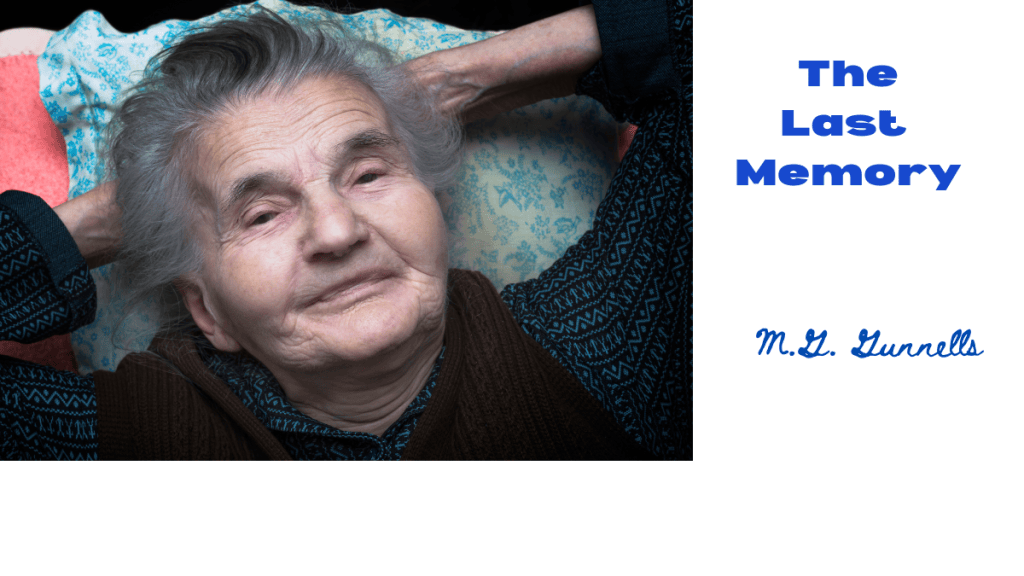
The Last Memory by M.G. Allan
Anna Vanderhoof turned her head on the pillow and saw herself standing by the bed.
Not herself as she was now, old and frail and bedridden, but a ghost of her younger self. The flaming red hair and color-filled cheeks, sparkling green eyes and strong straight posture of her thirties.
“Nana? Nana, can you hear me?”
Anna blinked, squinted her eyes, and realized she wasn’t looking at an image of her former glory but at her granddaughter, Rebecca.
“I’m still here,” Anna said, her voice a hollow croak that terrified and repulsed her.
Rebecca knelt down next to the bed, placing a hand over one of Anna’s. “So are we, Nana. We’re all here.”
Anna turned her head again, surprised by the exhaustion such a simple movement inspired. Scanning the room, she saw that she was surrounded by her family. Except for Rebecca, they seemed to be keeping their distance, as if wanting a buffer zone between themselves and mortality, but they were here, just as Rebecca said. All of them. Her two children, Edwin and Simone, both well into their fifties now, Simone’s husband by her side. Edwin’s wife had passed on several years ago. The half dozen grandchildren and their respective spouses, and even a gaggle of great-grandchildren of which Anna had to admit she only remembered a few names.
The Vanderhoofs were a large family but not a particularly tight-knit one. The only events that brought the entire clan together were weddings…and funerals.
“I’m not dead,” Anna thought, followed by, “Yet!”
To get all dramatic, the end was near; she didn’t need Dr. Danvers to tell her that. She could feel it. Her body was winding down, and she was just so tired all the time. Truth be told, she was ready. Ready to close her eyes and not open them again. She wasn’t afraid.
Okay, so that was a lie. She was afraid, but it was all mixed up with a certain nervous excitement. It reminded her of being seven years old and her parents explaining to her that they were leaving their home. Not just their house or their town, but the entire planet. They told her they were going on a spaceship and that they would live there for the rest of their lives. It was so big that Anna hadn’t really been able to comprehend it fully.
“It’s going to be an adventure,” her father had said, his usual tactic to convince her to do something she was iffy about.
The day they boarded shuttle that would take them to the USS Magellan Anna had not truly grasped the ramifications of the journey they were undertaking, but she had felt this same mixture of fear and anticipation. Stepping into the mysteries of the unknown.
Anna realized that she had become lost in her own thoughts again, returning to the present only when she felt the mattress shift as a five-year-old girl with blonde pigtails climbed up on the bed.
“Briana, get down from there,” Rebecca said, reaching for the girl.
Drawing from a nearly depleted well of energy, Anna swatted at her granddaughter’s hands. “Leave her be.”
Briana was the youngest of her great-grands and the one that Anna spent the most time with. The girl’s mother, Rebecca, was assigned as a nurse and the family had quarters adjacent to the ship’s medical unit, where Anna had lived for the past three years. Ever since the stroke that had made it difficult for her to get around on her own.
Briana snuggled up next to her great-grandmother, as she liked to do. “Tell me one of your stories.”
Gregory, Rebecca’s husband, said, “Honey, I’m sure she doesn’t feel like telling a story right now.”
Anna laughed. The sound was weak but it was the first authentic laugh she’d had in…well, longer than she could remember. “If not now, when?” she said. “This may be my last chance to tell a story.”
Simone took a seat in in a metal folding chair next to the bed. “Tell us one about Earth,” she said, and suddenly she seemed a little girl again, sitting cross-legged on the floor and looking up eagerly, ready to be spellbound as her mother unfolded one of her tales.
In fact, every face in the room held a similar expression. Rapt was the word for it. All the attention focused in on her like a laser filled Anna with a renewed vigor. She didn’t have much in the way of possessions or wealth to pass down to her loved ones, but she had her stories. She’d told them hundreds of times, and her family never seemed to tire of them.
Especially the stories of Earth. The tales of life on the little blue planet enthralled her children and grandchildren and now her great-grandchildren. To them, Earth was a myth; they had no personal experience of the planet.
Nor had anyone else on the ship. At 87, Anna was the oldest person onboard, and the last living person with actual firsthand memories of Earth. And those memories were about to die with her.
Only they wouldn’t. Her children and their children knew the stories by heart, and Anna had recorded them all for her personal log which upon her death would be added to the ship’s archive system. But reading the words on a flat screen, or hearing them passed down secondhand would never be the same as getting it directly from the source.
“Nana, will you tell us about the snow again?” Briana asked.
A soft murmur wafted through the room and everyone drew closer. Despite her exhaustion, Anna smiled and pushed herself up slightly on the bed. She hadn’t felt this much familial affection in years. A shame it took her impending death to bring it on.
“Well,” she said, and everyone leaned in as her voice was weak, “on Earth we had what were called seasons. Four of them throughout the year. Each lasted approximately three months, and contained its own unique weather patterns. The season we called winter was when it was coldest. In many parts of the world, it would get well below freezing and stay that way until spring.”
She saw several people around the bed wrap their arms around themselves, and next to her little Briana actually shivered as if she were feeling the bite of a winter wind. Of course, no one in Anna’s family had ever experienced true cold, as the ship’s temperature was always regulated at a steady 70 degrees Fahrenheit.
“And sometimes, when it got very cold, snow would fall from the sky.”
“Like the water that you said sometimes would fall from the sky?” asked her grandson Terrance.
“Rain, and it’s similar but different. When the temperature dropped too low, the rain would freeze and turn into these little fluffy ice crystals that would cover the ground in a blanket of white.”
Rebecca smiled, her eyes taking a faraway cast. “Sounds beautiful.”
“I saw pictures once,” Edwin said. “In an old book in the non-digital library. They were in black-and-white, but it was still breathtaking.”
Closing her eyes, Anna mined her memories, pulling up an image of the winter wonderland the backyard of her parents’ home on Earth would become after a heavy snow. Her body may be failing her, but her mind was as sharp as ever, and she could visualize the world of her childhood in precise detail. “Breathtaking, yes. Winter was my favorite time of year because of the snow. I’d go sledding, build snowmen with my parents, sometimes lie down on the ground, kicking out my legs and arms, to make snow angels. The world seemed a magical place all covered in downy white.”
“Must have been hard to say goodbye to all that,” Rebecca said.
“It was snowing the day we left.”
This got everyone’s attention. “You never told us that,” Simone said.
“It was the middle of January. There was a war going on, but like most seven-year-olds I was oblivious to it. While we waited for the car that would take us to the shuttle, I was playing in the backyard. The snow had drifted in places so that my legs sank to my knees, coming down so heavily that it was almost like a billowing curtain, and I tilted my head back and opened my mouth to catch the flakes on my tongue.
“When my Dad came to get me, I didn’t want to go. I was having too much fun, and I just couldn’t conceive of living the rest of my life without snow. He knelt down in front of me, getting his pants wet but not caring, and told me not to be scared, that I had to be brave. He said it would be an adventure then he took my hand and we walked away from the life I’d known.”
Silence filled the room then, a reverent hush like one might find in a place of worship. Briana was the first to break it. “Do you ever miss Earth?”
Anna considered before answering. “Not usually. The life I’ve had on the Magellan has been a good one, and I’ve never wanted for anything. However, if there was one thing I’d have to say I do miss, it would be snow. What I wouldn’t give to walk through a field of white again, watching the flakes fluttering down all around me.”
Briana gasped suddenly and wriggled away from her great-grandmother and off the bed. Without a word to anyone, she ran from the room, nearly colliding with Dr. Danvers who was coming through the door.
Rebecca called after her daughter, but the girl was already gone. “I don’t know what has gotten into her. I should bring her back and make her come apologize.”
“Don’t be silly,” Anna said, raising her hand in a dismissive wave then letting it fall heavily back to the coverlet like a dead bird. “Probably best one so young not be here for the end.”
No one responded to that. Anna figured they really didn’t want to talk about why they were all here, but it also couldn’t be denied.
Dr. Danvers stood next to her bed, smiling down at her. “Ms. Vanderhoof, is there anything we can do to make you more comfortable?”
Those words, spoken with such gentle concern, hit Anna like an anvil to the chest. They really brought home the reality that she wasn’t much longer for this life. Doctors usually told you what they were going to do, what you required, always looking for a solution. When they started asking you what you needed to be more comfortable, that meant they’d given up hope that anything more could be done.
Not trusting herself to speak, she just shook her head. Perhaps to make himself feel useful, Danvers fluffed her pillow and straightened the coverlet then existed the room again, leaving her alone with her family.
Anna found herself trembling, like she would as a little girl after coming in from the snow. Tears prickled at her eyes but she blinked them away. She’d had a long and full life, and she wasn’t in any real pain. This wasn’t the time to be scared, she had to be brave.
She licked her dry lips, swallowed hard, and was preparing to start her goodbyes when Briana came back into the room, her hands behind her back. She wore a sheepish grin that reminded Anna so much of Simone at that age.
“Where did you run off to, young lady?” Rebecca asked.
“I had to get something for Nana.”
“What do you have for me, sweetie?” Anna said.
Briana walked over to the bed and pulled from behind her back a small glass ball on a black base. Liquid sloshed inside, and in the dim light of the room Anna thought she saw something floating around through the glass.
“I brought you some snow, Nana,” the girl said, placing the ball on the bed.
Anna lifted the object with trembling hands and pulled it close to her. A snow globe. But not just any snow globe, the snow globe. She still remembered her father bought it for her at the shuttle station gift shop the day they left for the Magellan. She’d treasured it, even more so after her father died in her early twenties. She eventually passed the keepsake to Simone, who in turn passed it Rebecca. Rebecca had apparently continued the tradition by passing it to Briana.
Who was now giving it back to Anna. The circle closing.
Anna stared into the snow globe, at the winter scene caught inside. A small wood-frame house with a few white-capped pine trees out front, as well as a tiny snowman with carrot nose and a striped scarf. The miniature house didn’t really look anything like where she’d lived with her parents on Earth, but the resemblance was close enough that as a girl it had thrilled her. Those first few years aboard the ship, when the pangs of homesickness had been those most cutting, she had spent hours lying on her bed and staring into the snow globe, trying to will herself into the tiny submerged world.
Holding the snow globe now, she gave it a shake, stirring up the little plastic flakes that swam around in the water before settling back down at the bottom. A poor imitation of a snowstorm perhaps, but it was better than nothing.
She fluttered her eyelids, trying to blink away more tears, but the moisture persisted. She reached up a hand to wipe her cheeks but paused, staring at her hand as if she’d never seen it before. And in fact, she felt like she hadn’t, as if it were a stranger’s hand she was looking at. Gone were the liver spots and varicose veins and wrinkled folds of skin. The hand before her know was unlined, unblemished, the hand of a much younger woman. Perhaps that of a girl. This could be Briana’s hand.
As baffling as this was, Anna found herself distracted by dust filtering down into her eyelashes. Dust that melted and ran like tears down her cheeks. Tilting her head back, she gazed up at the ceiling…or where the ceiling had been. Now she only saw a swirling mass of gray clouds and tiny chips of white sifting down, catching in her hair and dropping onto her face, numbing her skin with cold.
“Snow,” she said softly, her voice sounding firm and sure. “It’s snowing in my room.”
That was, of course, impossible. She knew that and yet her senses told her that it was real. She could even see her breath fogging out in front of her in vaporous clouds like cartoon word balloons.
“Is anyone else seeing this?” she asked, lowering her eyes back to her family.
Who were gone. Not just them, but the entire room. She found herself standing in an open outdoor space, the ground at her feet covered with snow. She walked slowly through it, at times the drifts so deep that her legs sank down to her knees with each step. The landscape was familiar, though the perspective skewed. It was as if she’d shrunk.
I’m a little girl again, she thought. It’s impossible, all of this is impossible, but I’m a little girl, and this is where we lived back on Earth.
Even as she thought this last, she turned and saw the house, the wide back deck and the weather vane on top. And from around the corner of the house came her father, bundled up in that wool trench coat that he no longer needed once they went to live on the ship.
“Anna, it’s time to go,” he said, holding out a hand.
Part of her wanted to run to him and throw his arms around his legs, but another part shied away. “I don’t wanna go.”
He stopped before her and knelt down in the snow, getting his pants wet but he seemed not to care. “I know you don’t want to go, but you have to. It’s time, you can’t stay here any longer.”
She looked around at the familiar surroundings and felt tears sliding down the sides of her face. “But I don’t know what it’s going to be like.”
Her father placed a warm hand on her shoulder. “Don’t be scared. You need to be brave. It’s going to be an adventure.”
Then he took Anna’s hand and they walked away from the life she’d known.
MG Allan spent his childhood making up stories in his head, and now he spends his adult life writing them down.

Two Women by Toshiya Kamei
The silence in their apartment was heavy, packed with twenty years of things they hadn’t said. Emi and Kenji moved around it like two practiced dancers, their choreography perfected by routine. He would read the newspaper at the small kitchen table; she would pour his genmaicha, the roasted aroma a familiar ghost between them. They slept on separate futons, rolled out each night on opposite sides of the tatami room, two parallel lines that would never intersect.
It was a life built on a truce, a quiet armistice signed two decades ago. When he had first told her, that younger Kenji with fear-bright eyes, he had wept. He had shown her the clothes, the makeup, a hidden, softer version of himself. And she, a young bride terrified of the unknown, had made him choose. “Me, or that?”
He had chosen her. He had burned the dresses in a small metal bin on their balcony, the smoke acrid and mournful. He had promised.
Their marriage, stripped of passion, had settled into a kind of gentle companionship. They were partners in weathering the quiet disappointment of a childless home, roommates who shared a surname and a mortgage. Emi had learned to find comfort in its predictability. The silence was a blanket she had knit herself, stitch by careful stitch.
Then, the first thread pulled loose. It was the scent of cherry blossom, faint and floral, on his collar when he came home late from the office. It wasn’t her perfume. It wasn’t the scent of another woman, either; it was too delicate, too personal. A week later, she found a tiny, clear bottle of top-coat nail polish tucked into the back of his sock drawer. Her heart hammered against her ribs, a frantic bird in a cage.
She said nothing. She watched him. She saw how his gaze lingered on the vibrant silks in a shop window. She noticed the new, meticulous care he took in shaving his forearms, the skin left impossibly smooth. These were small things, almost invisible, but to Emi, they were seismic tremors before the earthquake.
The confrontation came on a rainy Tuesday. She had been folding laundry, the scent of fresh cotton a comfort, when she saw it. He was in the bathroom, the door slightly ajar. He thought she was still at the market. He stood before the mirror, but his posture was different—softer, his shoulders curved in. With a pair of her tweezers, he patiently, artfully, shaped his eyebrows.
The sight stole the air from her lungs. It wasn’t the act itself, but the look on his face in the reflection. His quiet, profound concentration. A look of homecoming. He hadn’t worn that expression for her in twenty years.
She pushed the door open. The tweezers clattered into the sink.
Kenji’s reflection crumpled. The mask of the stoic husband fell away, and behind it was the same terrified, hopeful person she had met all those years ago.
“Emi,” he whispered.
She held up the bottle of polish she’d retrieved from his drawer. Her hand shook. “You promised,” she said, her voice a thin, frayed wire. It was the only thing she could say. You promised. It held all the weight of their silent years, their childless bed, her carefully constructed peace.
He turned from the mirror to face her. He didn’t try to lie. The exhaustion on his face cut bone-deep. “I can’t anymore,” he said, his voice cracking. “I’m…drowning, Emi. Every day, I wake up and I drown a little more.”
He wasn’t asking for forgiveness. He was stating a fact. The truce was over. The war was lost, or won, depending on which side you were on.
“So what now?” she asked, the words hollow in the small, tiled room. “You will wear dresses? You will become…?” She couldn’t finish the sentence.
He took a slow, deep breath, and for the first time, his shoulders straightened—not with masculine resolve—but with a different kind of strength. A fragile, terrifying self-acceptance.
“I will become myself,” he said softly. “I hope…my name will be Akiko.”
Akiko. The name hung in the air between them, a beautiful, impossible thing. It crowded out Kenji, pushed him from the room, from their marriage, from her life. Emi glanced at the person standing before her, a stranger in her husband’s skin, and then at her own reflection in the mirror behind him. She saw a middle-aged woman with tired eyes and a life that had just been declared a tragic lie. There were two women in the bathroom now, and one of them was utterly, completely alone.
Toshiya Kamei (she/they) takes inspiration from fairy tales, folklore, and mythology.

Harvest Home by Sarah Das Gupta
Plates of newly baked cottage loaves,
wooden platters of ripe apples
green, brushed, touched with red,
round, juicy, tempting
as that fruit in Eden.
Butter, freshly churned,
a creamy, soft confection.
Round, lunar satellites of cheese
mimicking the full Harvest Moon,
shining golden in the autumn sky.
Laid out on trestle tables,
flagons of foaming beer,
eagerly poured into frothing tankards.
Whole well- cured hams
with coats of yellow bread crumbs,
await the silver carving knives
gleaming in the bright moonlight.
Harvest cakes drip
with white icing sugar,
amid bunches of golden- eared corn
decorating the harvest table.
Trout, fresh from the mill stream,
Lie open-mouthed and bleary-eyed
at the munificence before them.
Milk-maids in sprigged muslin dresses,
gather in a colourful crowd,
surveying the village lads
in smart smocks and breeches.
A fiddler is tuning up,
feet begin tapping to the old songs.
Shyly couples get in line,
ancient melodies accompany
the youthful dancers.
Moonlight floods over the empty fields,
the shadows lengthen among the trees.
The corn lies safe in wooden barns,
Music drifts out over the meadows.
The old rhythm of harvest celebration
throbs through the mothy darkness.
Sarah Das Gupta is a writer from Cambridge, UK who has lived in India, Tanzania and UK. Her work has been featured in twenty-five countries in anthologies and magazines.
Something went wrong. Please refresh the page and/or try again.