
I was ill and trapped on a fast train, the TGV, racing from the Charles de Gaulle Airport to Angers (pronounced Onjay). Nasal congestion, wheeze, and runny eyes were bothering me so much, the French countryside and the villages whizzing past were tiresome, not exotic. Why did I go abroad in this condition? My daughter had pleaded for help—a panicky reaction to her first pregnancy—plus my wife and I wanted to see her and the baby.
Actually, I’d imagined the need for this journey with dread five years before. That’s when my daughter, after a student exchange in Melilla, Spanish Morocco, began searching through Europe like a miner hunting for gold, and I began asking, mainly by telephone, “What’s wrong with American men?” She went through a Brit-John phase, a German-Sebastian phase, then a Frenchman phase. Those last two months turned out to be a pre-matrimony honeymoon. She’d struck the mother lode so to speak. Those damn romantic Frenchmen!
Not that I tried to stymie true love. In fact I blamed myself somewhat for her Eurocentric attitude. I’d encouraged her student exchange in Melilla after taking her younger self on two foreign vacations. Mea culpa. But, accepting her choice, I had also often warned her that raising the five children she claimed to want could best be done in Dayton, Ohio, our hometown. I wanted my only child (and her children, whatever their number) near me and her mother.
I might as well have talked to a tree. She’d married and moved here anyway.
So this tedious trip was making me dirty baggage, to be isolated and cleaned. My wife would live with the nursing mother and baby. I was to keep my germs away from them.
At the Angers St-Laud depot, the new mama bared baby’s countenance for me only a moment. Then they hurried home eight blocks away, pushing baby in un landau, with Grandma dragging her wheeled suitcase behind them. Off I went, dragging my suitcase, following the Frenchman to a doctor (an Iranian trained in a Boston med school). Then to un pharmacien for medicine the Frenchman paid for. Then to a wee apartment he’d rented for me. Yes, I was cranky, but I think I managed to hide that behind a mask of suffering.
Alone with annotated brochures and maps, I took an antibiotic with water from a pitcher in a half-refrigerator containing the French necessities of life—wine, brie, ham, and baguette—crawled beneath covers, and slept with the city clamoring through my 10th-floor window.
In America, even sick, I might have done a morning jog, but finding my daughter’s living space required walking, which at that point seemed better than straining myself. Finding a cab, communicating and paying a driver simply seemed beyond my capabilities. So, afoot, I followed the Frenchman’s scribbled directions on a map to my wife, daughter and grandchild. He was away, working. At my knocking, the two women came out onto the 2nd Floor landing, closed the door behind them, and talked at me from far enough away to avoid breathing the air I exhaled.
Baby was fine but sleeping. They were sorry I was in exile, but hoped I felt better. We’d all be together as soon as I was definitely not contagious. Therefore, I should rest and let myself heal. I should NOT go inside the museums or the Chateau d’Angers. They’d be so crowded, I might pick up some other bacteria there. However, the parks or the River Maine’s walkway would be good for a stroll if that appealed to me. In the evening the Frenchman would drop by my room with a meal they’d prepare. I was not to worry. Everything was dandy.
Those marching orders sent me wandering the streets of Angers, alone, just the French citizens and me. Wishing for invisibility, I remembered how the man collecting TGV tickets had asked for ours in English. So I suspected my identity as a foreigner was obvious even if I didn’t attempt to speak to anyone. Probably the way we dressed had disclosed our nationality. Maybe the way we carried ourselves. My haircut? Yes, I was not thinking clearly. I was feeling like what I was, an outsider.
In the nearest park (botanical) I took a meandering path through green vegetation of various sizes and kinds without curiosity enough to read the little signs announcing their identity. I felt lonely, but aromas from the earth and plants did remind me of walking through woods back home.
The paths were narrow, but I and the others politely kept our distance. We were aware of one another on only a superficial level, avoiding a collision or obstruction. I hoped that this separation continued. Closer contact would further alienate me from them, a visitor who spoke their language minimally and ruined its music.
I hiked away from the park on a street reserved for pedestrians, closed to motorized traffic, and entered Old Town. Most of the people here were hurrying, taking care of personal business. I was the opposite: ambling along aimlessly on the sidewalk near the buildings.
At a plate glass window displaying shoes, I stopped and looked in. The prices in Euros seemed twice the cost back home, assuming I was calculating correctly. How could the average person pay so much for such common necessities? I continued along the street oohing at the price of merchandise in window exhibits. Finally, seeing myself reflected in glass, I realized that I was acting like a sightseer, looking at everything and everyone as objects that might amuse or educate me. As things apart from myself.
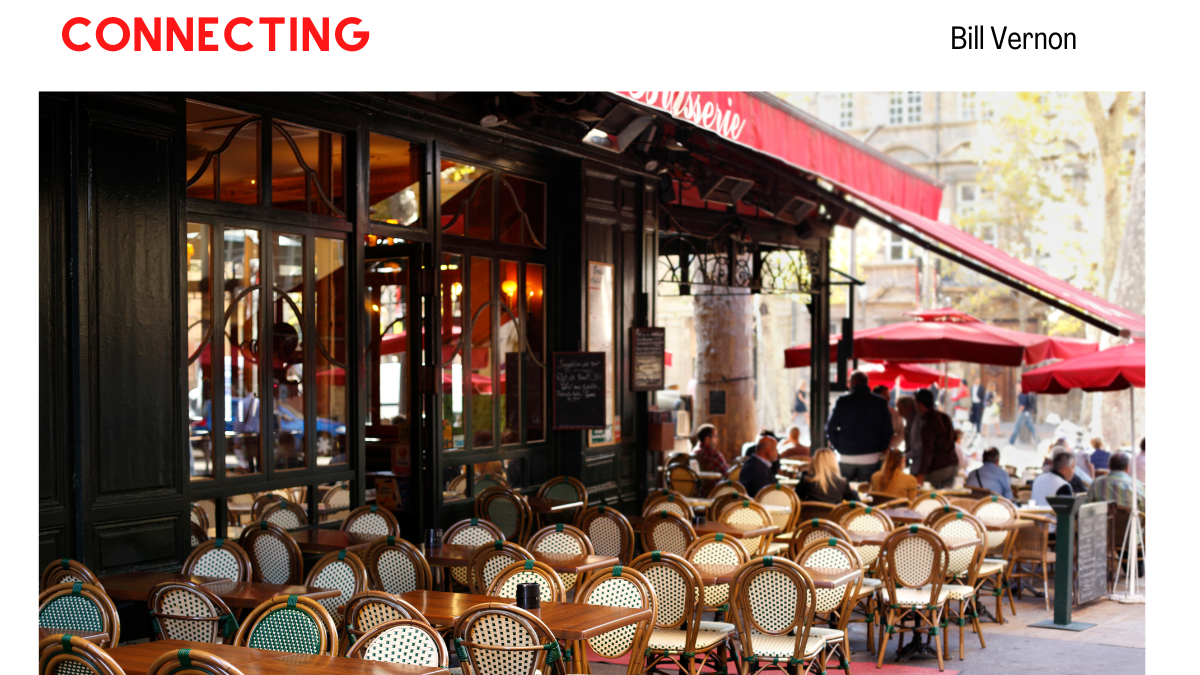
Walking farther, I did a double-take. There was my father ahead in the crowd. Impossible. The antibiotic had to be kicking in, causing a vision. I gawked as the man sat at a cafe’s outside table and greeted a waitress. A local man I was sure, but he resembled my father like an identical twin. I’d missed Dad forever since his passing from cancer when I was 14.
My father in fact, I remembered, had French ancestry, his mother a Dushong who’d become a Dishun when US immigration misspelled her name. He’d sold insurance because he liked people. He didn’t act as if he liked people just to sell insurance. Respect everyone, he’d always insisted. We’re all more similar than different.
On impulse I went to the nearby Tabac and held the door open for a woman who was leaving. “Apres vous,” I said, and Madame smiled.
“Merci.”
Minutes later, carrying a copy of today’s English-language Chicago Tribune, I glanced at the man and knew that he was a sign. My father was teaching me, from either above or inside myself, to think of the good things I have, not the negatives. And I imagined, in a day or two, kissing my daughter, holding my granddaughter, looking for Dad in their faces.
Bill Vernon likes exercising outdoors and doing international folk dances. Five Star Mysteries published his novel Old Town and recently published shorter works include fiction at Sykroniciti Magazine, Superpresent and New Feathers Anthology.
Comment