
Falling, cartwheeling through that single plane, the dimensions in which we could see were limited. At your call we had risen from the table and rounded the corner into the foyer. Your descent had already begun. Because we arrived perpendicular to the stairway and underneath the highest part we saw through the banister supports only a rushing shadow projected against the wall. When you opened your eyes you asked why the crickets were chirping.
Is the soul ephemeral or remote, and can it remember its previous flesh? Does it recall the laughter? You asked us this, lying there on the floor, and we were astonished. A fourteen-year-old child. We had come into the foyer to see your new party dress, but you selected a queenly elevation equating altitude with status. Upon hearing the scrape of our chairs you stood on the landing performing a slow pirouette in white lace. The headache came suddenly, images imploded behind your eyes. Then the fall through darkness. You heard our voices afterward, that was all, and asked us: Do the crickets die in autumn?
You were taken into a white room and placed on a narrow table, your head held immobile. The table moved on a track into a white tube. Later, people in white coats looking drawn and sad told us about the tumor. Your vision had returned by then, and when they told you — and us the second time — you became pensive and refused to look at us. You said: When autumn comes the leaves will change.
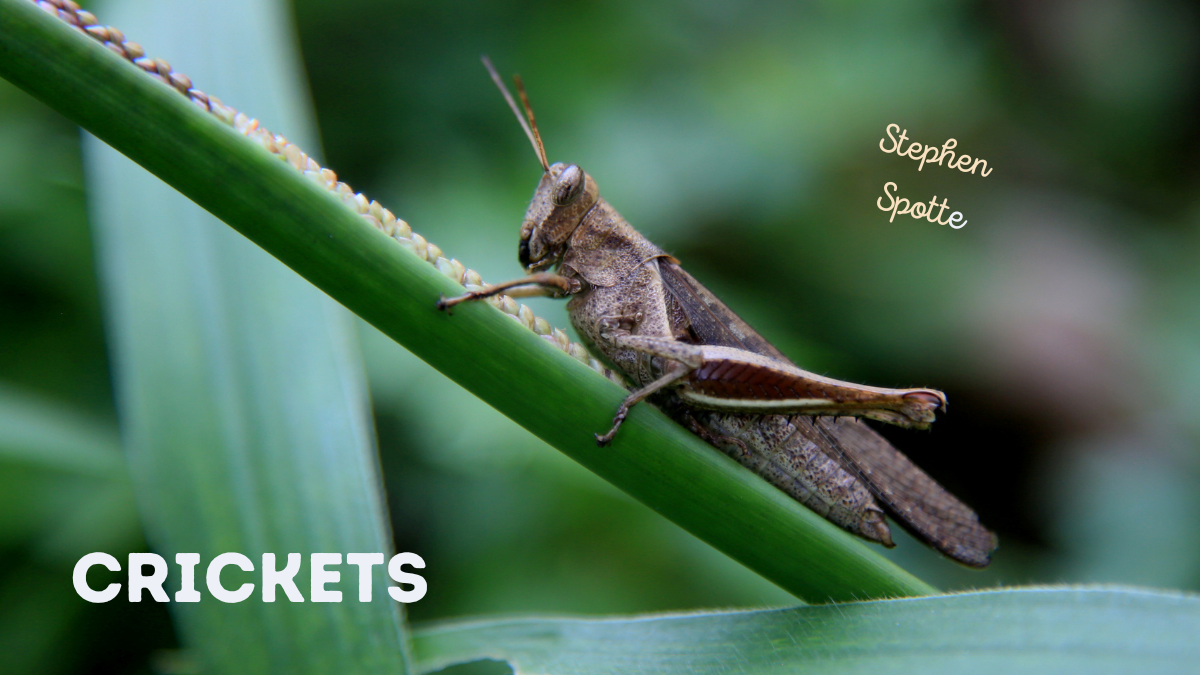
We returned home in late summer to find a cricket dying on the doorstep, its legs moving slowly. The antennae twitched on the head turned to one side. The humped torso gave a final convulsion. Find me a cricket, you said.
We bought a cricket cage of lacquered bamboo shaped like a pagoda. Its bars had been painted red and green, colors of the dragon. Inside we placed a cotton ball soaked in sugared water. As if in a dream we hunted crickets by flashlight, descending to the woods through plasmic tendrils of fog. Shrouded trees blocked the moon. A cricket chirped, and we stopped. It chirped again, but when we moved it turned silent. By dousing the lights and standing still we gained its confidence. Finally, we traced its voice to the base of a rotten stump where we tore frantically at the soft wood, pulling it away in soggy lumps until the cricket lay exposed, shiny and black. We caught it in a jar and went home triumphant.
It was midnight, but the clock struck only once. You were standing on a chair at the mantel, slim and white in the moonlight. The glass front of the clock was open, and you were turning back the hands, refusing to let another hour pass. Stepping down, you asked: What is death? After a moment we answered that death is a dream, the dead are dreaming, and our memory of them is a dream too. We meet in our dreams, awake or asleep. Then this cricket is a dream too, you said, and no sooner did we put it in the cage than it started to chirp.
We never saw you model that dress: the pirouette, movements modest and contained, an economy of motion. Overnight, your glance had become steadier, less furtive; hands that had stifled giggles dropped away; hair worn up, high heels and smooth legs, knowledge that an amethyst broach deepened the blue of your eyes, you expressed it all. But a smile is impermanent, like folds and creases on the sea’s face. Speak to me, you demanded, so I can remember your voices. You meant against the time when your presence would cast no shadow against the wall, when you would be a shadow.
But it was we who should have asked. We saw only your outline: white teeth, pale eyes, a figure lithe and quick and sure in its gravity, occupying its space. We should have asked who you were. Which reality is greater? The springing frog or the ripple it leaves on the surface of the pond? Has the frog truly left or does it remain embodied in concentric, attenuating circles? And when these are gone, does everything remain, or nothing?
They were part of you. Your own traitorous cells dividing, radiating outward from the brain, streaming through the blood, numbers multiplying exponentially. They masqueraded as you, lodging in kidneys, liver, lungs, spine, pressing on the optic nerves and occluding vision.
Plant a tree over my ashes, you ordered, so its roots entwine me, absorb me, feel my elements surge into its phloem; see me then, a disturbance of green leaves in sunlight. And in autumn when things die again, catch me as I drift back to earth. How could a child speak like this, gain such prescience in so short a time? Can dreams of death accelerate the acquisition of wisdom? Is living truly a dream within a dream?
We dream of you nightly, but during the day too. We ask people in the streets: Have you seen her? They turn to us, faceless. Certainly, they reply. She was here and then vanished, like that! Fingers snap. We see the dreamlike movement of hands but hear no popping sound.
From a bridge we look down and ask a fisherman: Have you seen her? Yes, he answers, she surfaced once against the rising sun. The face was a silhouette, but it was hers. Yes, maybe it was her. It might have been.
Do they fight against the bars?
Does who fight? Against what?
Crickets. Do they fight against the bars of their cage? I can hear my cricket singing. It sounds the same, but how could it? I hear the ghosts of crickets. They’re sighing.
The soul isn’t a single entity. It slides sinuously from one to the other, linking us together — sister, daughter, friend — until our dreams unite. Until we hear as one the tiny exhaling of insects.
Stephen Spotte, a retired marine scientist, is author of 25 books, 82 scientific articles, and numerous short stories and nature essays. He lives at Longboat Key, Florida
Comment