
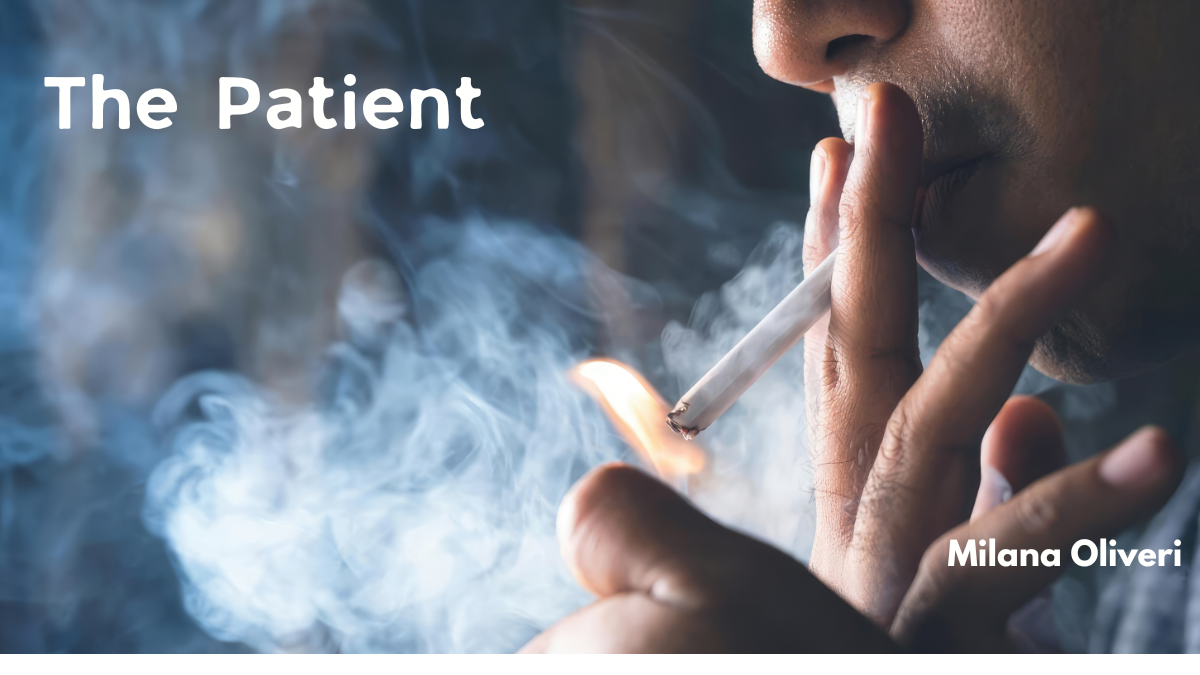
They called him The Patient. He was a man who promised himself “one more time” and didn’t know why. One more cigarette after work. One more shot while he gambled one more bet. One more missed call that he’d explain later, when he had the energy to sound like someone who was sorry.
At first, it was small things, things that seemed to pass. He skipped family dinner one night and told his wife he was staying late at work. Stayed out during his youngest’s birthday and came in late with booze on his breath. There was a fight that day, one where his wife told him “one more time” and she would lose her last shred of patience with him. He had held up his hands and shouted that it wouldn’t happen again, that he was sorry.
There was one day when he woke up and swung his legs out of bed to brush his teeth but collapsed instead. Claimed he had a piercing pain in his chest, and if he died make sure the life insurance would be paid out. His wife drove him to the hospital and they checked him out, said there was nothing wrong with his heart or his lungs.
“You were lying, weren’t you? About the pain?” his wife asked on the car ride back. Her hands were clenched tight on the steering wheel, and The Patient wondered if it was possible to dent it.
“No,” he said.
“You were.” She glanced at him. She had always been pretty to him ever since their first meeting a decade ago, all freckled cheeks and ruthless determination that he fell in love with, but now he looked at her and saw her sagging jawline, narrowed wrinkling eyes, and lips pressed so tightly they would never come undone.
“You’re getting old,” he said. “I know a guy up in the town over who does facial lifts.”
He knew his words were the wrong thing to say. He could tell by the way something cracked between them.
He stopped coming to family dinners altogether. Whenever he was home, he slipped into his room and spent his time watching TV, worthless movies and videos that only passed the time and numbed his brain. The pain in his chest was still there, but this time he only rubbed the spot and kept quiet.
His youngest child’s friends would come over and he would hear them through the door, talking in their high-pitched child voices, full of curiosity and words that knew no boundaries. Sometimes they played. But most of the time, it was questions directed to his youngest, queries that would be considered rude among adults but normal around children.
“Is it true your father’s sick?” one of them would ask quietly.
His youngest, brave soul that he remembered her to be, would make excuses for him, why she never saw him, why he was always in his room. And maybe there was some part of him that regretted it, that still wanted them to be a family.
“I don’t know,” his youngest muttered. “He’s busy today. That’s why the door’s shut.”
“But he’s always busy,” another would chime in. “I heard he doesn’t even work anymore.”
“It’s only a rumor,” she would say hastily. “Let’s go play.”
The Patient would binge-watch movies while his youngest played, waiting for the time when the front door would open and shut, sweet goodbyes being called, promises of I’ll see you soon. He remembered times when he had done that, when he cared about those missed calls. But it was all a bargain, he thought. I’m not holding my side up anymore. It’s fallen.
The next day, he didn’t go in to work. One more drink, he said to himself. And then I’ll go home.
By the time he opened the front door and took off his muddy shoes, it was midnight, and his wife was waiting by the door with an expression on her face he couldn’t decode. It occurred distantly to him that he had promised to take his oldest out to his soccer game today.
“Look–” he mumbled. It was more like a slur, thick and broken and full of unsaid apologies.
“I’m sorry,” she said quietly. “I can’t do this anymore.”
Neither can I, The Patient felt like saying, but he only nodded. He tried to paste a forgiving expression onto his face, but it felt flat, clumsy. He was suddenly conscious of his sweat-soaked jacket with a whiskey stain on the collar, of his jeans that he’d been wearing for months by now, of his oily hair and unshaved jowls.
Early the following morning, he awoke to hear the sound of a suitcase bumping down the stairs. It paused at the bottom, and he swung upright, wincing at the sudden pain in his head from the hangover that was only supposed to be “one more drink.” His fingers brushed the crushed couch cushion, and for some reason he remembered a day long ago, when his wife arranged the new couch and told him, ‘Let’s not sleep on the couch, dear, shall we?‘
His oldest shuffled his feet, a teenage expression akin to anger on his face. There was a time when they had been nothing more than father and son, who played catch in the backyard and went to soccer games together. There was a time when the rift between them could have been patched with Band-Aids and race cars and Star Wars movies, but that time had slipped away, and The Patient looked at his son from across a valley.
“Why?” his oldest burst out, clenching the handle of his suitcase with white-knuckled fingers. Green eyes. The same color of his own, the same shape, the same heavy brows. It seemed like yesterday that his oldest was toddling through this room on unsteady legs and a fat diaper.
“I don’t know.” It was the best explanation he could offer. He felt a sudden urge to reassure. “You’ll be okay. Go back to school. Don’t drop out to take care of your mom.”
Those heavy brows drew lower, and the person staring back at him was no longer his son.
The suitcases were loaded into the truck. His wife had always preferred the truck. She finished buckling his youngest and looked back at the house, at him. There were things to be said, but he didn’t know what to say. The bed of the truck was still open, and there was a bungee cord dangling.
“Your cord…” He motioned. She went over and fixed it. Looked at him with hardened eyes. Inside the cab, his youngest pressed her face to the window and stared unashamedly out with all the raw, deep grief of a child. He felt the ghost of her small arms around him.
His wife smiled one more time. The sun was shining on the side of her face, casting the other in shadow, and for a moment, it was ten years ago and they were newlyweds making promises of lifetimes to each other. She in her white dress and he in his black suit. Or was it blue?
“You know,” she said, “there was a time when I thought you – we – could work it out, that we could overcome whatever…problems you were having.” She lifted a hand resentfully in his direction, her smile gone like a mirror shattering. “But that’s all gone now.”
The Patient stared at her, absent-mindedly rubbing the spot over his chest with two fingers. As she drove away, he wondered if it could have been different. He wondered if it was because of him, or it was because of her, but he knew either way that there was a line drawn behind him, and he had just crossed it.
Maybe, deep inside in the hollow part, there was a piece of him that regretted it. Maybe it could have been repaired. He turned away from the street and opened the chipped front door. There was still a wreath hanging on it with ivy woven in just as his wife liked. It tilted slightly as he walked past.
He didn’t fix it. Nor did he wipe his feet on the doormat. One more time, he said to himself. One more time.
The Patient was a man who was hanging on by a thread, who promised himself that one day it would all change. “One more time,” he used to say as he downed another shot, smuggled another week’s pay to fuel his gambling desires. Now he told himself “Next time.”
The next time he opened his eyes, he was on the floor, a spilled bottle of rum soaking into his week-old clothes. When he staggered upright, he glanced to the side table, expecting to see his new clothes set out nicely by his wife. It was empty, bare of decoration, just plain cherry wood and an old doily crumpled in the center.
And the house was silent.
He turned suddenly and tripped into the bathroom, vomiting into the toilet until he was just dry heaving, tears dripping down his nose and into the bowl. Alcohol burned more coming up than going down, and there was no one there to rub his back and no one there to say it’s okay, and no one to pretend for, not anymore.
He remembered his wife saying, “I always thought vomit was green when I was young,” and his younger self snorting into his drink. He remembered buying her the Mercedes she wanted in a lime green. He remembered the sound of her laughter, mingling with his in the sweltering afternoon sun.
Another dry heave. There was nothing left to come up.
The toothbrush holder was emptier than usual. One green toothbrush tipped on its side, white and black bristles softening and spreading with use. He reached for it and hesitated. There used to be two.
Instead of brushing his teeth, he washed his face, wiping his unshaven stubble with the clean white towel. His eyes were dull and soft, wrinkling around the edges like worn paper, and his hair had grown lank and knotted, curling around his neck in a way that reminded him of a way he had said One more time.
He remembered coming back from the hospital and telling his wife that she looked old. It was the first crack in the valley, but then it snowballed from there. You’re a liar, he told himself in the mirror. Maybe you don’t need to care. It’s already gone.
He passed the kitchen, full of cracked bottles and unwashed dishes, and stopped at the entrance to his oldest son’s room. The bed wasn’t made, and posters of cars and sports covered the walls. He lifted a baseball bat from one corner and hefted it gently. There had been a day when he gifted this to his son, when he had told him to treasure it. It was the only item he had left behind.
“I’m sorry,” he said.
His youngest’s room smelled of soft hugs and friendship, of forgiveness and excuses, of hope and of dreams. He ran a hand over the pink princess coverlet. There had been tears cried here and joy expressed. It was the bed of an innocent child.
“I’ll miss you,” he said.
When he shut the front door, he locked it and looked one more time back at the tilted wreath. He noticed a small chrysanthemum poking out from the side, wilted and half-dead, its petals turning crispy. He reached and pulled it out, crunching it in his fist, letting the petals drop to the doormat. His wife had always disliked chrysanthemums.
Then he turned and walked down the block, tossing the key into a neighbor’s flowerpot as he did so. He touched the spot on his chest, the pain now a distant, constant throb, and he thought, if he died, make sure the life insurance would be paid out. But there was no one to make sure it would be paid out, and there was no more life insurance.
“Next time,” The Patient told himself.
Days began to pass more slowly. The Patient stopped measuring time by the work day and began judging by the sky. Dark sky meant night, it meant bottles, it meant isolation and relief and losing himself. Light sky meant day, and he never knew what to do during the day anymore. The day was just a period of time to pass before night.
During the day, he would go into restaurants and order free water, sitting on a hard stool at the counter and watching TV till his eyes would burn. He never chose the same restaurant twice, always leaving before anyone could get used to seeing him there, always gone by the time the routine had started to get familiar.
He would wander the streets with his coat wrapped tightly around his neck, wishing for a scarf and letting his mind drift into oblivion. He watched families on the street and noticed their closeness, their obvious attachment to each other. He wondered how many of them were wearing masks.
There would be conversations at the bar, drunken words and blind promises whispered into his glass. There were days when he would apologize to the amber liquid, and there were days when he would rage at it instead. A young server with brown hair asked him where he came from.
“Why would you care?” he said.
Down the street, on the dark asphalt, a few children were drawing with chalk, bright lines against dark, shouting to each other, pointing out mistakes in drawings and laughing about them. One boy dropped his chalk, an emerald green that hit once on the road before cracking in half, two big chunks surrounded by crumbs.
The Patient’s hand tightened in his pocket as the pieces rolled to his feet. He stared at the green before crouching slowly, picking up the bigger half, conscious of the kids staring at him, conscious of the whiskey sweating through his jacket.
“Here.” His voice cracked from disuse, and he tried again, softer, aiming his words to the boy. “You dropped this.”
The boy took it carefully, the freckles across his nose smeared with dirt, and nodded in thanks. The Patient wondered if he had said the right thing.
The Patient rose to his feet, looking down at the other half of the chalk lying in his palm. Maybe his wife would have smiled again, his oldest would have asked to play catch in the backyard, and his youngest would have pulled on his sleeve, asking him to draw something with her.
Then, he slipped it in his pocket and kept walking. His chest hurt again.
Next time, he thought.
Milana Oliveri is a young author who loves writing. This is the first short story that she has published.
Comment