
Twigs snapped underfoot as he trudged towards a patch of thistles and milkweed huddled down the slope. Stalks reached up, cracking open the robin’s-egg blue sky, and fronds loomed, forging a place of dark shade and silence. It made Tanner jumpy, but that was nothing new. The jumpiness was a thing in his bones now that he couldn’t pry out if he tried.
Twisting into woodland, everything was full of mingling scents: leaf mold, fresh morning dew, decaying birch and crushed coneflower seedheads, sickly sweet in the wind. In the old days, he’d never guessed forests held so many smells, that a slight gust could make or break his day, that a dampness touching the breeze would be so clear, like being pelted with water balloons as a child. But that was a different time, he’d been a different size then.
Russo coughed beside him, as if to bring Tanner hurtling back to the moment. Russo kept hacking, then wiped his mouth. He hadn’t sounded well lately. It was the springtime air. Pollen like pellets in the lungs. “We better get a move on.”
Tanner carefully stepped into the high grove of milkweed. Something yellow with zebra stripes skulked in the distance, but settled back on its perch. He clambered up, unsheathed a knife. It was a good clean cut into the milkweed pod, withering on bare ground. White silky cords tumbled out, soft as kitten’s fur.
Russo brought the sackcloth close. They grabbed as many white strands as possible, sweeping floss into the bag. Their movements were precise and fast. Still, Tanner’s forearms burned wildly from the sap. He wanted to curse, but Russo was once a religious man and Tanner never could glean Russo’s stance on blasphemy these days. These weren’t things people talked about much now. He grimaced, plunging his arms into a long bulb of dew overhanging them both.
A great swooping occurred. A terrifying routine moment in which Tanner thought, “This is the end.” Rather than thinking of Christopher or Ainsley, rest her soul, the only deranged thought he mustered was that it was a beautiful day to die, and he’d never pictured dying on a beautiful blue-sky kind of day.
It was only a Monarch; its snout forming a spiral black curl. It flapped silently, once, twice, then gone.
“Scared the bejesus out of me.”
Tanner’s heart pounded. The quiet morning loveliness vanished.
They returned to base camp, a sparse collection of aluminum and tin barracks, most already corroding.
Argyle hobbled toward them, face red.
“What is it?” Tanner dropped the sackcloth and fine threads spilled out. “Chris?”
“No, nothing like that.” Argyle’s hands fiddled with his own staff as he searched for words.
“Spit it out.”
“We need to move on.”
“Move on?” He looked at Russo.
Russo shrugged apologetically. “It’s like I’ve been trying to tell you. Been getting a sense. The Lord directing me maybe.”
So, he still believed in God. Tanner noted this for later. It was good to keep a mental file of those in the barracks.
They walked past pebbled walls and trenches as Argyle and Russo babbled about atmospheric pressures, and dew on leaves, and the damp woody musk polluting the air.
“What on God’s gigantic earth are you two on about?”
Argyle gulped, swallowing harsh words, “I can feel it, in my bones. A rain coming. A big one. Ever since, well… you know. It’s more like a crushing python squeezing at my joints. We’re not on high enough ground.”
Argyle couldn’t even say the words. Tanner scoffed and goaded, “Ever since what?”
They both looked down. Argyle still wouldn’t say.
Tanner glanced at the calm azure of sky doubtfully. “So, the boogeyman entered your bones and now we abandon camp?”
Argyle found his tongue, “It’s finally gonna wash away the region. The last of the sewers are long clogged up. No one to manage the old rain gardens. Not enough permeable surfaces in the street-lands. We had it good these few seasons, but it’s gonna spill down here like Noah’s flood.”
It was easy to forget that in another life, before The Reduction which Argyle couldn’t even bring himself to acknowledge now, he’d been a respectable meteorologist. In the days of television evening news, warm comfortable sofas, and pizza delivered to your door. Tanner tried not to think about old days. No use working himself up into a miserable stew of pity and loss.
“There’s no such thing as a second flood, fool!” He spat the words at Argyle, looking to Russo for help. Russo’s eyes remained downcast, perhaps reliving horrible memories. Argyle stood confused.
“Genesis,” Tanner clarified. “Noah is promised by God that the next time he ends things there won’t be a flood.”
Russo’s head darted up. He pointed at Tanner, as if delivering a homily, and snarled, “And you don’t believe God lived up to His promise? That His solution wasn’t a bit more creative this time around?”
Tanner was taken aback. He’d never seen Russo so upset.
Russo spread wrinkled hands out to the world before them, “Who’s speaking foolish now?”
Tanner grabbed the sackcloth, climbing the rails to aluminum shelter…home. The rest always insisted it couldn’t be true, but Tanner swore he could still smell the Sprite, and this scent of fizzy citrus had become a thing of warmth for him.
Inside, Christopher played with the other boys and girls, chasing, giggling, and shrieking past cots. Holcomb’s boy nearly bowled Tanner over as they fled outdoors. Chris went to slide past, but Tanner held him by the nape of his shirt.
Careful out there, no running off today.”
Chris blinked at him, with those clover-green eyes, still so young. “Dad,” he said as if Tanner were being impossibly thick, “running off is the whole point of tag.”
“No jokes Christopher,” he shook his head and let dead seriousness leak into his voice, “not today, of all days.”
Chris blinked again, going silent, emotionless, like when he was younger and a ball of sleet pinged off aluminum in the night, causing the other children to cry, terrified of the next insectoid or behemoth.
He patted Chris’s hair, sent him out, knowing perhaps he’d said too much. It was Wednesday. He still kept track.
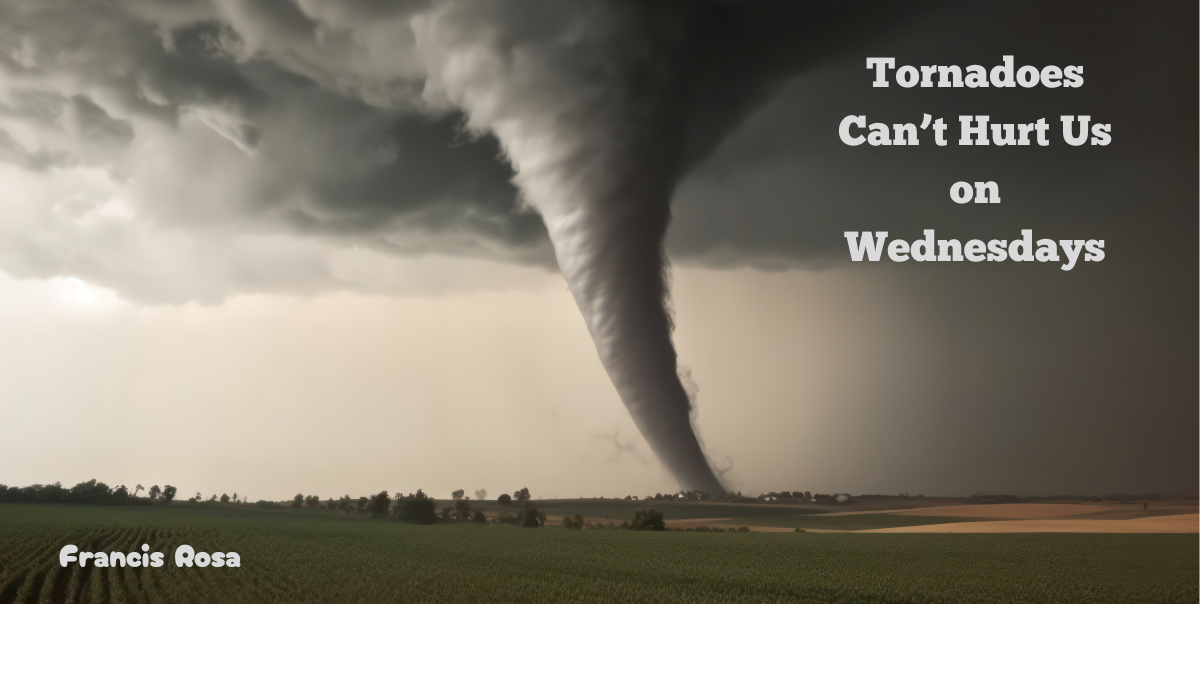
Tornado sirens pressed into the ears at noon like a terrible omen, petrifying Chris. Even before he could talk, he’d be curled in this ball, hands clasped over his head. Tanner and Ainsley tried to make Chris understand: It was only a drill, a bright blue Midwest day, clear skies, no tornadoes. It’s just Wednesday, and that’s what they do in Green Bay on Wednesday, a mundane thing really; they practice for the swirl of destruction everyone secretly agrees will never come to pass.
He stuffed milkweed floss gently into his boy’s pillow. New cushioning would help his son sleep more soundly, end any night terrors. The room was peppered with coughing; folks bent over in cots. Pollen sent folks into a tizzy this time of year, yellow particles gripping some with fever.
Holcomb arrived frowning. Tanner didn’t like this; he’d heard mutterings all morning. Everything carries in the barracks.
“Gonna need a lot more of that milkweed fluff for any kind of flotation device.”
Okay, now he was pissed. “Who in hell says I’m making a flotation device?” he snapped.
Holcomb shrugged, “It’s your funeral. Rest of us are already packing.”
“Packing?” Jesus, just like that?
“Where are the kids?”
“Still out playing, wasn’t gonna break it to ‘em yet. Give ‘em a few good hours and I’ll gather ‘em up and explain. The trek will be hard on ‘em, I’m sure.”
“You’re not breaking shit to my son.” Holcomb had always been a scoundrel. Tanner didn’t trust him as far as he could spit. Which, come to think of it, was an awfully short distance these many years.
Holcomb just shrugged again, sauntering off to rouse others.
Tanner pictured the barracks abandoned; the corroded cylinders that had become their world, a ghost town. What a ridiculous thought. Perhaps they’d all secretly given up, decided to walk into the abyss and hope for a quick end. Known dangers were always preferable to unknown dangers. Were they too stupid, stirred up with Argyle’s prophesying, to get that?
He marched outside, determined to give Holcomb’s confederacy of dunces a piece of his mind. In the heavens, birds chittered like thunder. In the north, a strand of clouds floated in, shaped like bales of hay. Tanner was spotted before he’d covered half the distance to the men, already gathering up wagons built of duff, and thatched of twigs, and saplings, and clay to keep supplies dry and shaded.
Russo tugged him by the arm. They walked amongst old fungus and moss beds, talking as slugs raised their heads in the distance, like cattle with stalked eyes.
“This has become crazy. A sudden deadly impulse. It’s gotta end.”
Russo kicked at crumbs of soil. “How you holding up?”
“It’s a tough day. Anniversaries are tough. Never mind that, what’s our plan? Abandon all on a hunch—”
“People trust Argyle’s judgement.”
“—on a hunch! And wander through the barrens of nature in search of higher ground? Even if you’re right, a great flood comes, you’ll never get out of the marshlands and into hills fast enough. You’re talking weeks, not days, on the run from everything.”
Russo’s face turned particularly meditative before he spoke next, perhaps preparing for Tanner’s latest outburst. “We’ve been talking, and we’ve been thinking about alternative shelters we might reconsider.” He pointed to blocky highlands far on the horizon.
Tanner’s blood went cold. “You’re going back to that? Over a creak in a man’s bones?”
“Many feel the turning of seasons out here is too hard to bear.”
He sighed. A memory fragment struck him. The early days, stuck in that basement, a concrete wasteland. They’d been down there for the tornado drill, blankets and hot chocolate ready. That’d show Chris it wasn’t so bad, it could even be fun. Squeeze this bizarre fear of Wednesdays out of him. They’d been beside each other; most weren’t so lucky.
At first, he’d assumed he was falling, a fainting spell or stroke perhaps. They spent a week unsure if they’d ever make it back up the stairs, surviving on water in a pond formed from a leak too small to even notice before. They braved unspeakable cold, and cobwebs, and dust falling like soft snow.
Ainsley, his dear wife, was snatched up so very fast. The spider reached out casually and quietly, like it was just borrowing her soul for a few minutes. This crustaceous thing endowed with endless limbs, jaws, and eyes. Christopher stood there and watched, not a single tear coming to his eyes, not a flinch. Just staring, too young to understand, as if it was all a curious game of peek-a-boo.
Then sirens exploded. They were automated, sounding off even with no one large enough left to monitor them. Chris curled into a ball. Tanner carried the boy away.
Tanner returned to moss and duff. “What you said to me today, as we left the patches, you really believe that? That the end, rapture, revelations, whatever the words, has already come?”
Russo sighed, “What other explanation do you offer?”
“What does that make us? The leftovers? The sinners?”
“That would imply we’re all eternally bad people, yourself included.”
“And the children? Christopher?”
Russo raised an eyebrow, went silent. Perhaps this was why Russo never sermonized. He could have united them, like flies around honey. People love a sublime message in dark times. But maybe Russo didn’t know what to say about the darkness, didn’t accept the answers he prayed over.
“You were at Lambeau for chrissake! Homes weren’t built for us, they were built for our ancestors, for titans. Mother Nature, she provides all we need now.”
Russo motioned towards the barracks, “You live in a bottle of pop, did Mother Nature provide that?”
Tanner started to reply but he’d lost the thread of what he was arguing for. Folks had already made up their minds, scared senseless. It was a sad thought.
In the beginning, the scared rushed to connect, form shelter, tribes, some semblance of society. But houses and offices were alien kingdoms now, dens for pests, fierce, vicious, often gargantuan predators. Former riches, luxuries, and power meant nothing. A lone crumb cannot live in a god’s palace very comfortably.
This lesson took time. Locals who survived the initial shock of The Reduction headed for these palaces. They trekked up Lombardi clambering through rough pavement and halls like canyons to gather on football turf. A grand encampment in a great coliseum. Home of the Packers, now the cradle of civilization. Then pigeons arrived, along with gulls, gigantic thunderbirds descending on the unsuspecting. The rains came, drainage proved useless with no one to maintain it. Rains brought mosquitoes and flocks of gnats that transformed open flat terrain into a horror scene.
It was a tough lesson for a species used to ruling the world, desecrating it for sport, and building upon its own might, to suddenly discover they must hide in shadows, creep along, and abandon all its achievements and notions of grandeur if they were to survive.
Tanner shuddered. What were homes anyway? Caved in, towering Everests, weathered, crumbling, covered in silky arachnid threads. Lands of nests, hives, and varieties of mold and mildew, grotesque jungles of plague. Mold spores like slick festering pebbles could sicken and kill a man in one foul breath, coating frail lungs in tendrils.
The camp was named after Ainsley. Now it would be left to corrode, until the last man who ever littered, whipping a can of pop in fresh grass beside the road, was long gone.
Cloud cover darkened the mossy hollows. Tanner stormed off through duff trails, where everyone rushed about. Argyle and the older folk were insisting loudly they felt danger in their bones.
“Threatening to squeeze me dead,” Argyle claimed.
Tanner re-entered the barracks. Christopher was packing away his life, pulling milkweed floss from cushions and pillows, stuffing webs into makeshift rafts to keep them extra buoyant. Holcomb and others directed the children’s efforts. Heat rose into Tanner’s face. He clutched his son’s shoulder.
“Is it true we’re all leaving?”
Tanner shook his head. “Christopher, you’re staying right here.”
Several kids turned with confusion, searching the other parents’ faces for confirmation.
Holcomb, that weasel, tried to laugh it off. “Chris bud, we’re all going, your dad just means you have an extra special job. We need you to give a final check around the encampment so we know we didn’t forget anything.”
Tanner clutched Christopher’s shoulder tighter, so tight Christopher flinched. Shit! He relaxed his grip, “We putting words in each other’s mouth today?”
Russo stepped between Tanner and Holcomb, pulled Tanner aside whispering, “You make him stay and you’re handing him a death sentence.”
“I’m not subjecting him to… I’ve told you what it’s like in those basements.”
“It’ll be different, you’re not alone, there’s more of us.”
“For chrissake, a colony of earwigs doesn’t care how many of us there are when they drag us away in some dead sap’s baseboards.”
All three of them had been huddled in the basement, Tanner hushing Chris, explaining once again that it would be all right. It was just a drill. It was Wednesday, remember? What did we talk about? Tornadoes can’t hurt us on Wednesdays. There’s hot cocoa to sip. Then the floor had lurched towards him, and the cobwebbed ceiling had become a firmament.
By evening Chris was glued to the railing, playing mindlessly with a strand of milkweed floss, like a yo-yo. His eyes stayed downcast as others wheeled out, sick folks coughed the whole way, blazing an arduous path up the slope towards a stand of blood roots.
Folks were a dot waning on the horizon, then gone. Then silence.
The sky grew darker. There was a rumble at nightfall. Toads sounded off like cannon fire from a great distance. Something big scuttled about in the moisture and heat. Tanner moved them both inside. The rains pounded, rapidly washing over the barracks in a tumult. Rivers formed in crevices. The encampment became a pond, then a lake. A rush of water bowled them both over. The can was lifted from wet soil and they were cast about in the dark hideous tin-screech of the capsule.
Tanner was sure they’d die. He prayed. In all this time he’d nearly forgotten how, but now the muttering and clasp of hands came back to him like lines in a play, like he’d always been careening towards this. He hugged Christopher close.
It let up at dawn. They crawled out of the soda can. It was tipped over; stuck in wet clumps of milkweed groves he’d been picking from the day before. The water level had risen immensely. They should be drowned. He carried Chris, shivering and horribly bruised, into daylight and followed the tracks of others. Mud made the glide of wood and wheels easy to follow. Dead worms lay like derailed trains along the path. Drops of condensation fell like landslides. He found them at noon.
They eyed him like a ghost when he appeared. Folks were in rough shape. There hadn’t been enough time. Supplies had washed away in the storm and uneven ground. Stalks of flowers had fallen; ants had raided the wagons.
Russo stared at Chris protectively, hobbled over and asked, “You doin’ alright kid?”
Chris nodded solemnly.
This was a lie.
Tanner understood then he’d never be able to quite make things alright for his boy. The fact, such an obvious stupid thing, at last came down on Tanner like a sledgehammer. He stood there and took it calmly, patting Chris’ sopping hair.
Ahead lay the foothill of a curb, and beyond that was a long ocean of craggy pavement; an unknown to come.
Francis Felix Rosa is an avid reader and conservationist. His fiction has appeared in the museum of americana, Hidden Peak Press, and elsewhere. A wandering New Englander, he currently resides in Green Bay, Wisconsin.
Comment