
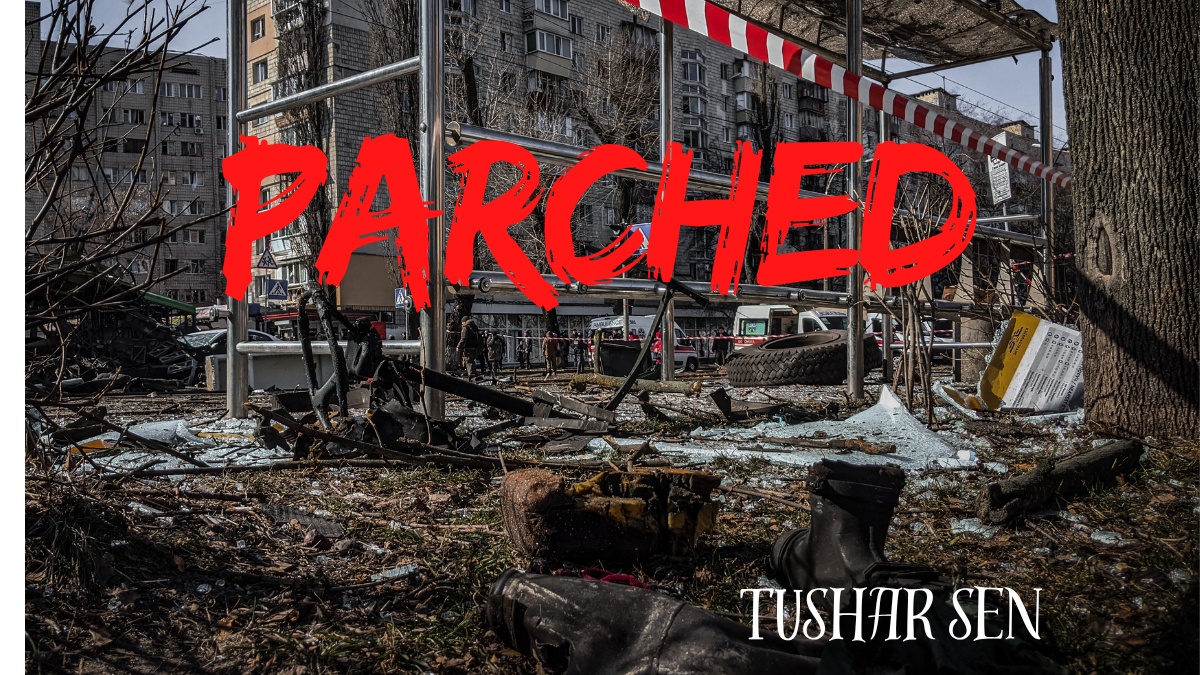
A bomb fell—
like a rogue kite,
stringless, nameless,
aiming nothing, claiming everything.
Blisters on that body—
like boils on bubble wrap,
waiting, bursting, multiplying.
The place hissed,
like a silenced furnace
breathing through broken walls.
In the market square,
a skull lay atop a fountain,
choked with blood—
to ward off the spirits
of those who died a “natural death.”
Fresh rubble,
still warm,
drew hands the way gold does.
Not mourners, collectors.
They came softly,
like it was a harvest.
Shoes were eased
from the feet of the buried
without asking for permission.
Gemstones pinched
from fingers gone cold.
Piggy banks split open—
their small treasures
up for grabs.
Business as usual—
no one took notice,
no one complained.
Barrows carried bodies—
unclaimed,
hurried to a deep patch of earth
dug out to accommodate them all.
Ambulances stood in the heat,
with hospitals gone,
medical aid
traded by the roadside.
The city now heard
only sirens,
craving baby cries.
A stray rocket stuck on a rooftop—
ashamed of its own sterility,
hiding its nose from passersby
who pelted rage-filled stones.
Outside shelter homes,
the queues never thinned.
Somebodies and nobodies
waited their turn,
hoping for a roof tonight,
some hot stew maybe—
or perhaps not.
Tushar Sen is a finance professional who also engages in sustained creative and scholarly writing. He is the author of Pandora’s Box, a collection of short stories available on Amazon, Barnes & Noble, and Audible. In 2020, he wrote and produced the short film Zulfi, which screened internationally and received 22 laurels across film festivals. His essay, “Vishnu’s Umbilical Cord,” was published by LongformReads (https://longformreads.com/2026/03/28/vishnus-umbilical-cord-how-a-quantum-entangled-type-iii-civilization-answers-a-5000-year-old-question/). His poetry has appeared in Lekh (https://lekh.co/the-poems-winning-aint-the-road-less-travelled-and-the-quill/) , Indian Review (https://indianreview.in/poetry/the-waiting-room-tushar-sen/) and SpecPo Verse (https://specpoverse.org/vol-2%2C-issue-1-2026)
Comment